
Harmony in the Summer Meadow:
The Sun’s Heat and the Ether of Warmth
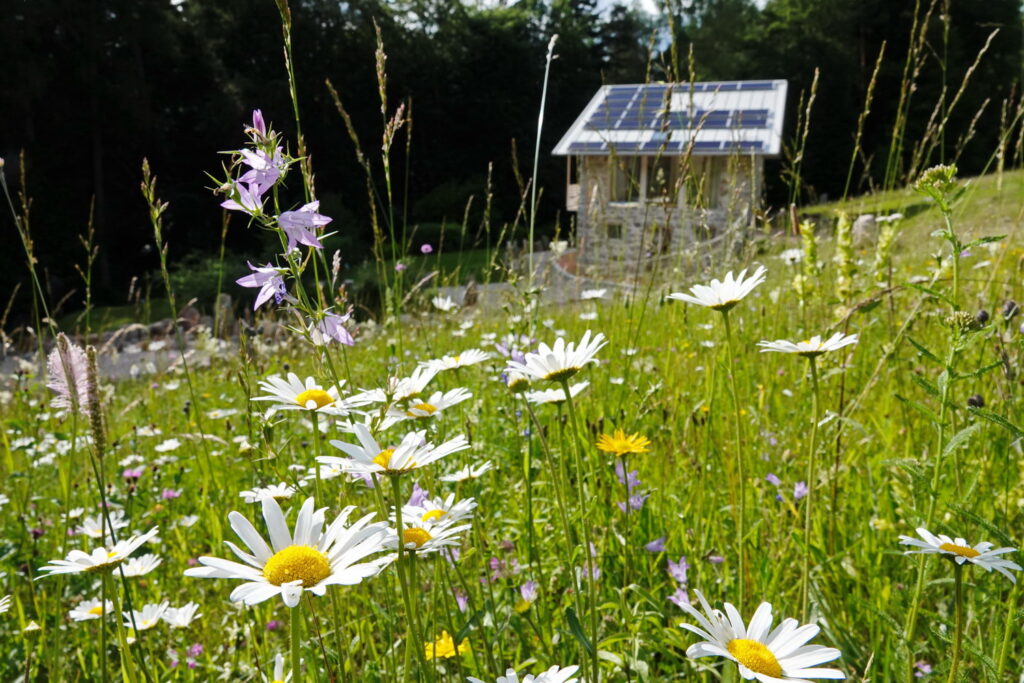
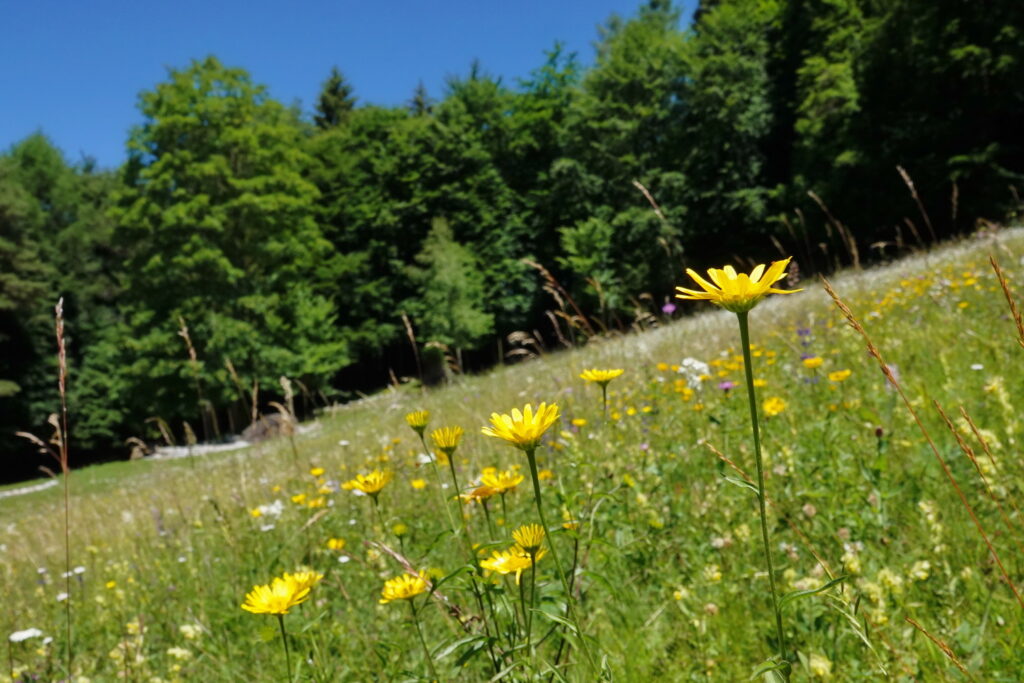
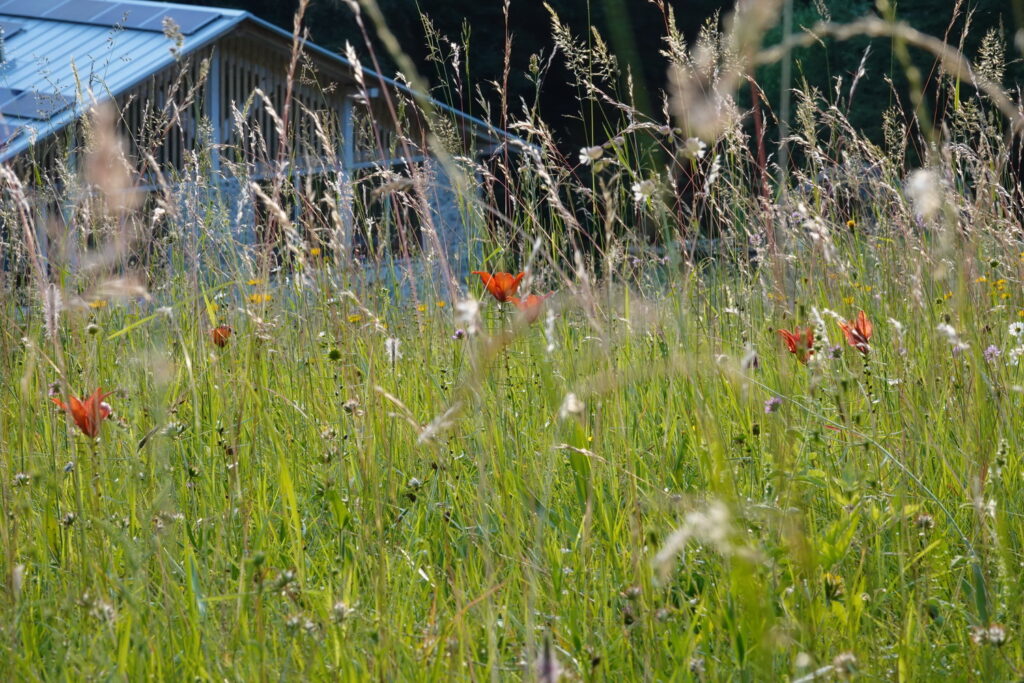
The beautiful flower meadows in the Naone project, now in full summer bloom, deserve further attention. As a related thought or perspective, I would like to raise the question today of the relationship between a single flower and the meadow as a whole.
Let’s take a flower:
a daisy, a bellflower, meadow sage,
and ask ourselves various questions:
:
Does the plant stand alone, isolated? Does it give the impression of being connected to the others? How is that connection formed? Harmoniously, or disharmoniously? Does the flower get lost in the diversity of a meadow, or does it retain its distinctive character? Is the meadow as a whole so dense that one no longer perceives the individual flower? Is the meadow as a whole like a fundamental harmony that gives the soloist—the flower—its space?
These illustrative questions are intended to encourage us to consider these relationships. This can be done using the photos from Naone, but even better using a flower meadow that one actually sees before one’s eyes or recalls from one’s own memory (1). If one does not see or know of a flower meadow, one can imagine one and thereby even inspire the future in a culturally creative way. (2)
Presumably, the answer to these questions won’t lean toward one side or the other. Perhaps we’ll come to realize that in nature there is a wonderful balance between the emphasis on the individual—the flower—and the overall impression—the meadow.
We may realize that this question cannot be definitively answered once and for all when it comes to a meadow. One might get the impression that on one day the plants appear more scattered and disjointed, while on another day they seem connected, vivid, and harmoniously integrated. Admittedly, these are quite subtle differences, but such questions can help train our observation and perception.
The light alone—in the morning or evening, in spring or fall, in Central Europe or the Mediterranean region—gives a meadow a specific character at any given moment. (3)



To further illustrate this point, I’d like to share a brief anecdote. It happened 12 years ago, but it remains as vivid in my memory as if it were yesterday and serves as a valuable guideline for observing nature. I had the opportunity to accompany Heinz Grill on a trip to Egypt. (4) The hotel was located on the banks of the Nile; across the river, my gaze swept over fields, palm trees, and several mountain formations. It was my first time in Egypt, and I was completely overwhelmed by the beautiful, warm light; everything seemed so harmonious and vivid to me, unifying and inviting—even the hotel’s concrete facade. I described this impression to Heinz Grill, who agreed. And then, after a brief pause, he clarified:
„It is the ether of warmth that creates this impression; that is the correct way to put it.“
This taught me to look at things in a more nuanced way. It is true that nature always finds a harmonious expression and is always permeated by sustaining life forces or etheric forces. These etheric forces have already been discussed several times on this page. They act as fundamental forces in nature, but depending on the constellation, they are present with varying degrees of intensity and have a strengthening effect on nature.
When observing nature, therefore, one’s attention can be directed toward this fleeting phenomenon: How does the flower meadow appear today, right now, in terms of differentiation and connection?
The impression of a beautiful, tranquil order; a balanced relationship between the individual and the whole; the simultaneity of differentiation and connection; a three-dimensional light that emphasizes rounded forms—these are some characteristics drawn from scattered descriptions by Heinz Grill, which can serve as criteria for observing what is known as the “warmth ether.”
„The individual stands out, but so too does the diverse, the multiple, in every way. One might say that this is simply the way it is. But there is also a mystery associated with the fact that there is a singular, unique entity—impersonal in nature and personal in human beings—and that this uniqueness is not separate from the other, that is, from the rest of the natural conditions. One could pose this question as the basis for the perception of the warmth ether, for it is precisely this question that has to do with warmth.“
Heinz Grill
A forward-looking approach to nature conservation could be to strengthen these etheric forces (6). This is a very noble opportunity and responsibility for humanity; for as human beings, we are not only permeated by etheric forces, but are also fundamentally capable of creating them—to promote nature, our fellow human beings, and the environment, as well as to strengthen our own health. (7)
Text, Images, Videos: Lilly Zahara, 12.07.2026
(1) Photography, with its technical characteristics, and the photographer, with his or her awareness and creative vision, have the ability to highlight certain aspects; this is one of the strengths of this medium. However, the coexistence of near and far, of the individual and the whole, can never be depicted in photography exactly as humans experience it.
(2) Using lavender as an example, Heinz Grill pointed out that creative, concrete meditation practices can help shape culture and inspire the future. See the article “Lavender: A Subtle, Gentle Connection to the Cosmos” on this page.
(3) See the articles on the qualities of light: (English translation coming soon)
Qualitäten des Lichts: Blütenhafter Osten, streichelnder Westen
Licht als Flamme: der feurige Süden
Licht differenziert und verbindet
(4) The thematic outcome of this trip is a brochure titled “The Idea of Rhythmic Interaction.” It is the written version of a lecture given on site by Heinz Grill on the culture of the feeling soul in ancient Egypt and its implications for the present day.
Erhältlich im stw-Verlag, auch als eBook
(5) Expansion of the quote:
“One might ask oneself […] why a tree in the forest is not experienced as a single entity in and of itself, even though it does represent a single entity. Why are even a blade of grass or an ear of grain experienced in connection with their entire surroundings? One might ask this question: Why, when looking at a particular detail in nature, do we not experience that detail in isolation, but rather experience it within a context?”
Heinz Grill in: “Light and Heat Forces in Humanity and Nature: Foundations of Spiritual Vision and the Structure of Etheric Forces,” a brochure published by stw-Verlag in 2014, S. 14f.
Erhältlich im stw-Verlag, auch als eBook
(6) „[…] Through the way each individual forms thoughts, feelings, and ultimately their will or volitional stance, etheric forces—that is, life forces—are created. In this way, human beings can make an active contribution to building up and maintaining the health of the entire world organism, the various environments, and their fellow human beings. It is all too easy to forget this fact: that human beings are at the center of creative power. It is not only good food or good water that provide this opportunity; rather, human beings themselves can exert an influence on their environment and can also develop healing powers that benefit others or, more broadly, every human being..“
Heinz Grill in: “Forces of Light and Heat in Humanity and Nature: Foundations of Spiritual Vision and the Structure of Etheric Forces”“, Broschüre aus dem stw-Verlag 2014, S. 9
Erhältlich im stw-Verlag, auch als eBook
(7) See Heinz Grill’s four-part series of essays, “Spiritual Healing and Its Practical Application in Life,” June 2023, published at heinz-grill.de