
What is the butterfly doing on the towel?
The woodworkers in Naone are delighted by the distinguished visit.
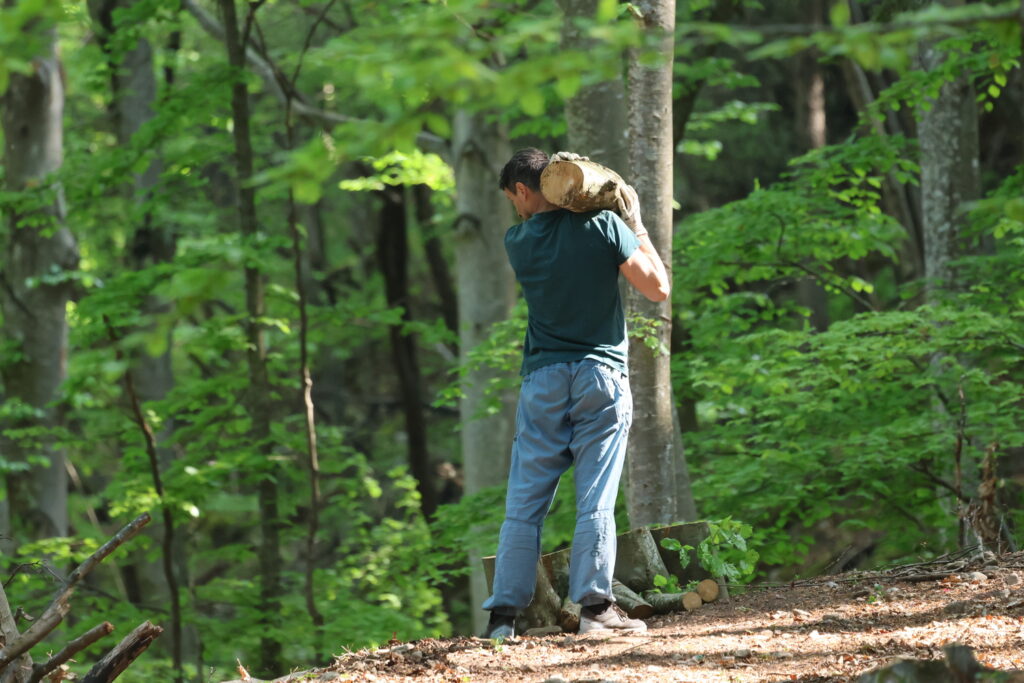
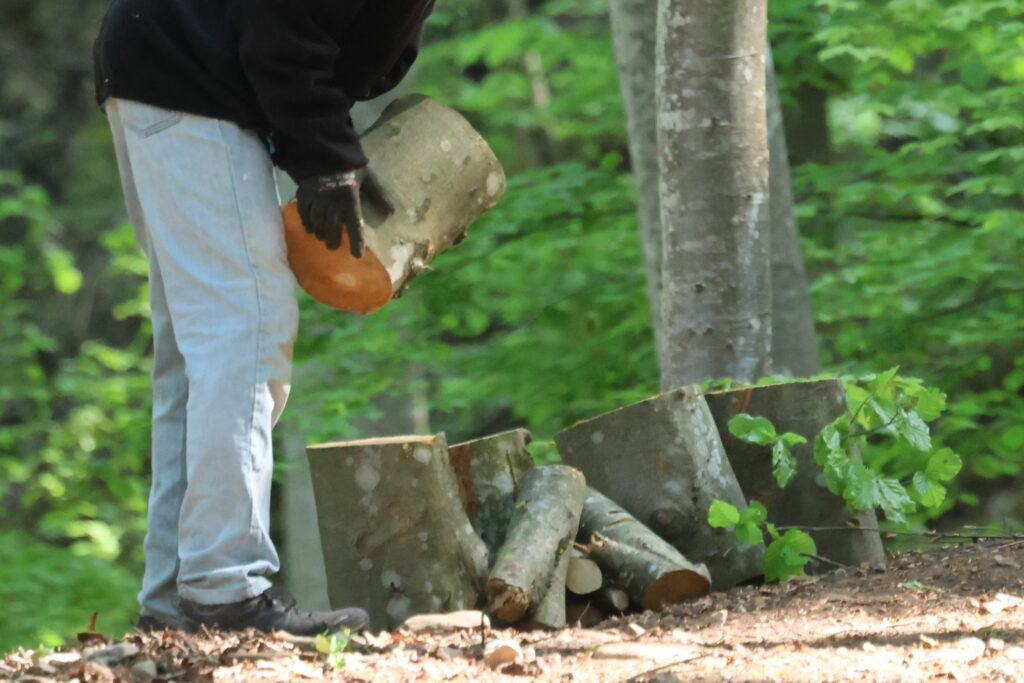
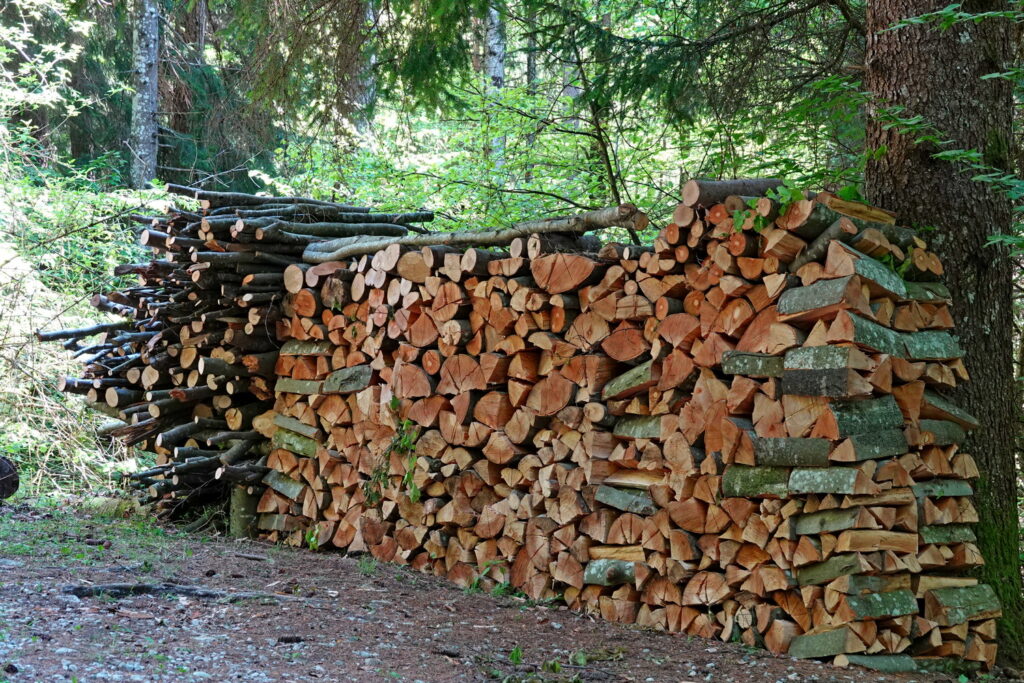
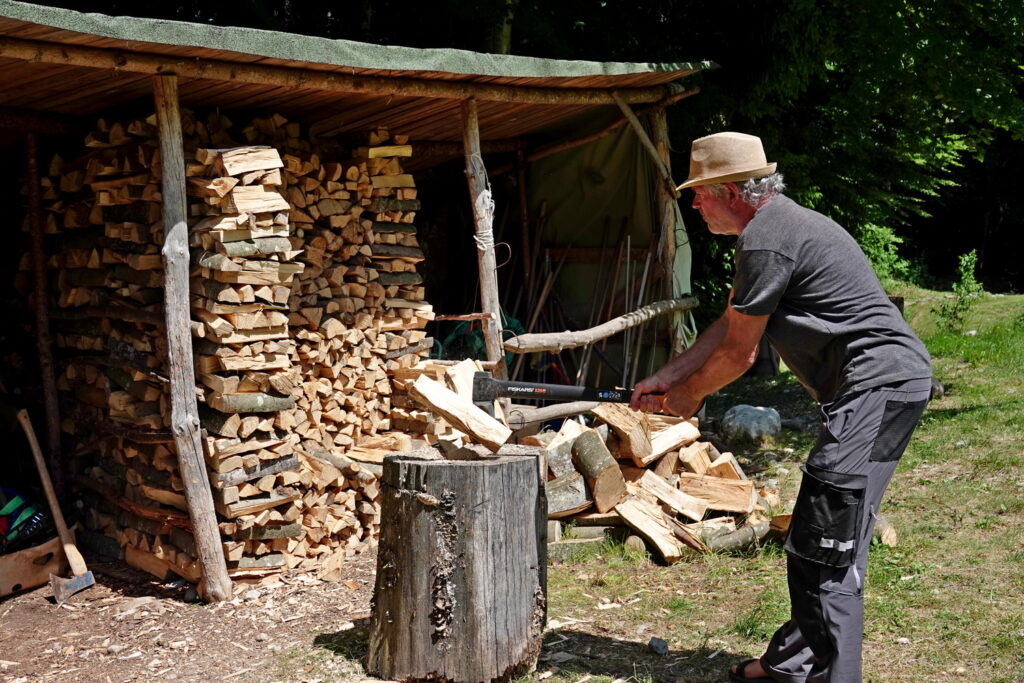
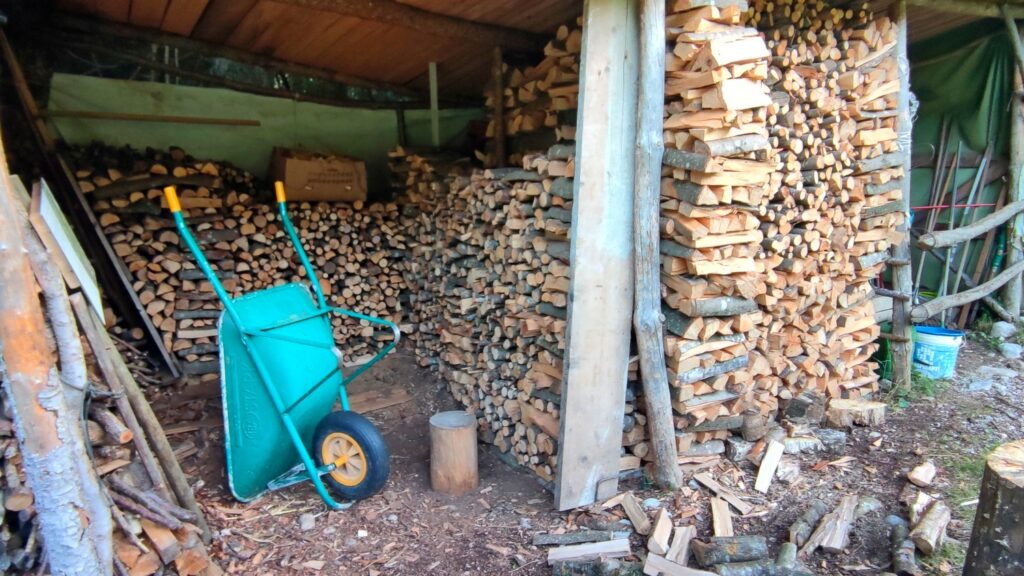
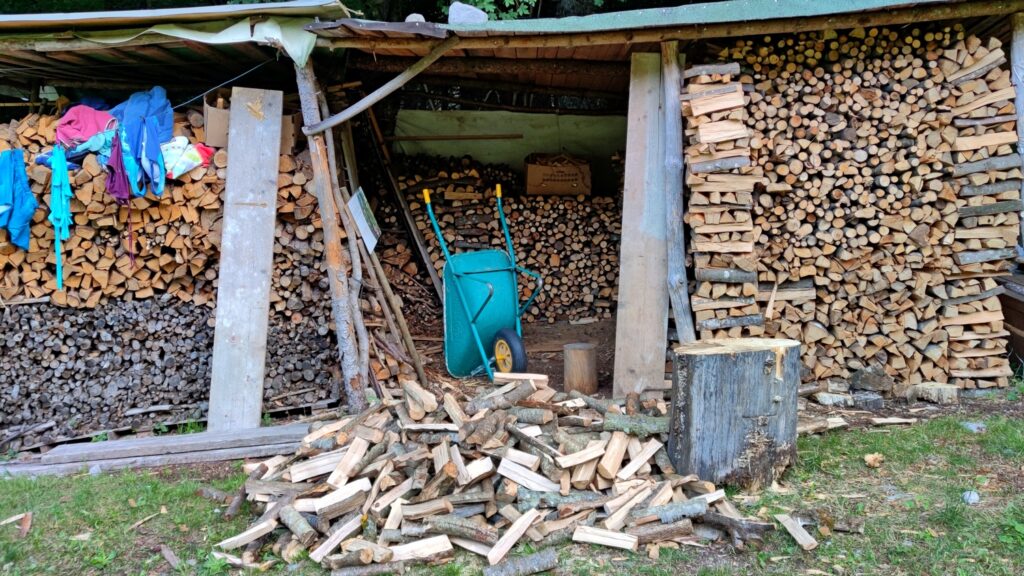
Wood warms you three times, as the saying goes: when felling the tree, when chopping it, and when heating it. Since the Naone meditation and seminar house is heated with wood, gathering and preparing the winter supply involves a considerable amount of work – and therefore generates a lot of warmth. And all this in the sweltering heat of summer!
The sweat-soaked towel hangs over the clothesline – butterflies gently alight on it. Are they looking for a resting place?
Butterflies flutter over flower-filled meadows; we associate them with colorful blossoms. But sweet nectar isn’t the only food source butterflies appreciate.
Even if it’s not the image we like to think of: urine, carrion, or feces also attract butterflies—or even sweat. It’s the minerals in these substances that are both attractive and essential for their survival.
Who are these distinguished visitors to our woodworkers?
Both butterflies are quite large and have a striking and bold pattern.
The admirable Red Admiral
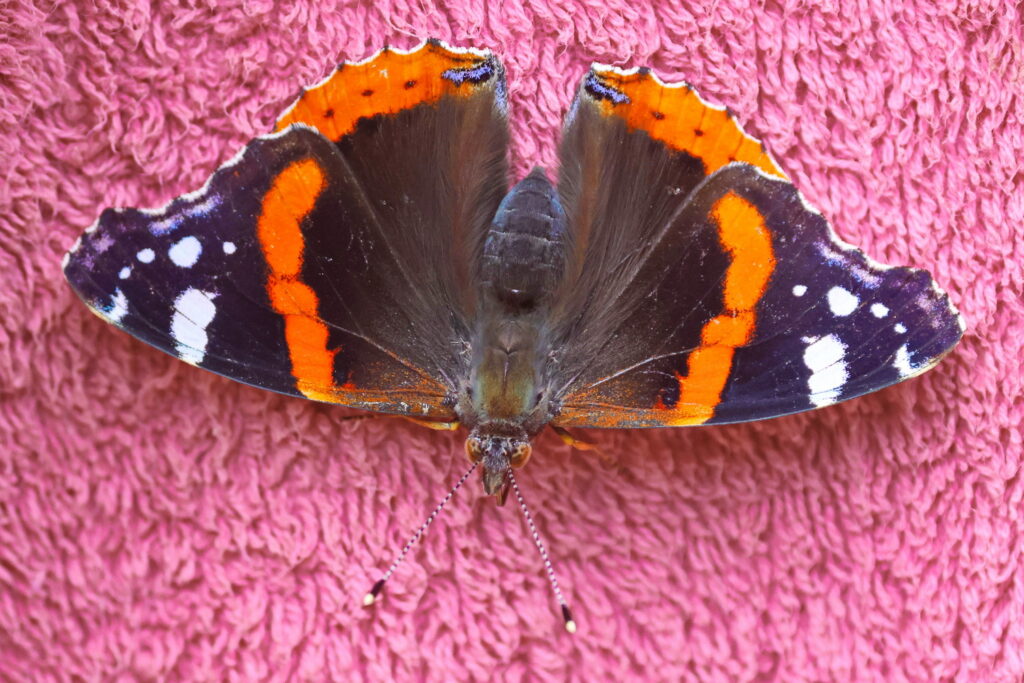
The distinctive and rather large Red Admiral butterfly, Vanessa atalanta, is probably a familiar sight in late summer and early autumn, often seen on butterfly bushes, hemp-agrimony, or asters. Its name sounds almost militarily austere, yet it softens sweetly into the Latin “admirabilis,” meaning “admirable.” The most beautiful specimens can be seen in our region later in the summer.
„The Red Admiral butterfly has an air of exoticism: it is not native to the region, but a visitor from the south, unable to survive the Central European winter at any stage of its development. It arrives in May and June, only to leave again in autumn.“ (1)
As a classic migratory butterfly, the Red Admiral leaves its wintering grounds in Southern Europe and travels across the Mediterranean to our latitudes. In early summer, these long-distance travelers lay their eggs on nettles; the caterpillars develop inside closed leaf sheaths and hatch after two to three weeks. Due to climate change and warmer conditions, migration routes and behavior have changed significantly over the past 20 years, and year-round populations are increasingly developing in Central Europe, provided it remains mild enough for the adult butterfly or at least that fresh green nettles are continuously available for the caterpillars.
Besides flower nectar, the restless Red Admiral butterfly enjoys the sweet juice of fallen fruit, preferably pears or plums. Although it generally prefers warm climates, it dislikes excessively hot summer temperatures. At such times, it retreats to cooler forests, mountains, or more northerly regions. Only in autumn does it once again appreciate open, sunny areas, seeking them out to lay its eggs.
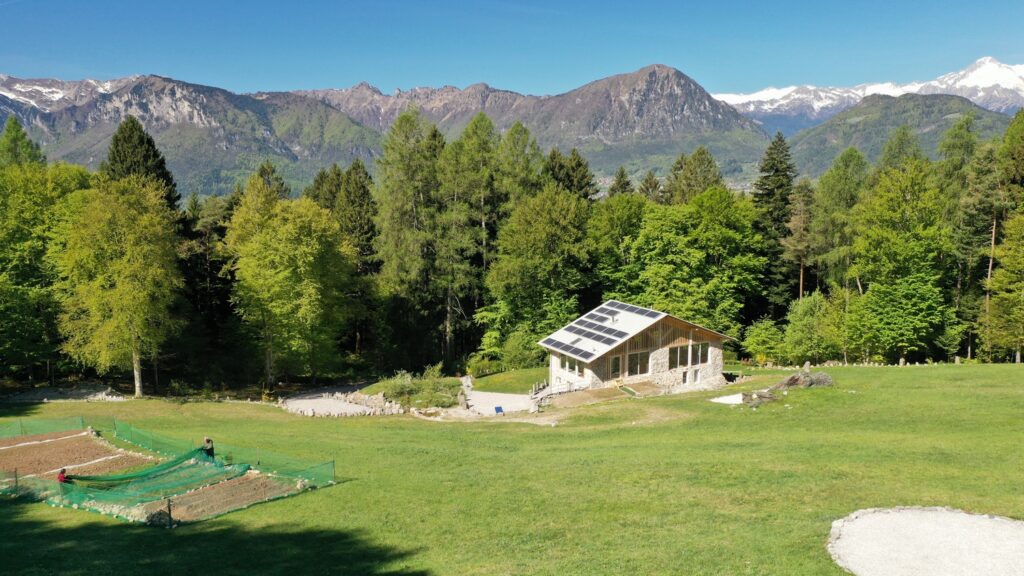
Many factors may have combined to lead this beautiful Admiral butterfly to the mineral-rich piece of fabric in the forest clearing of Naone.
The Poplar Admiral
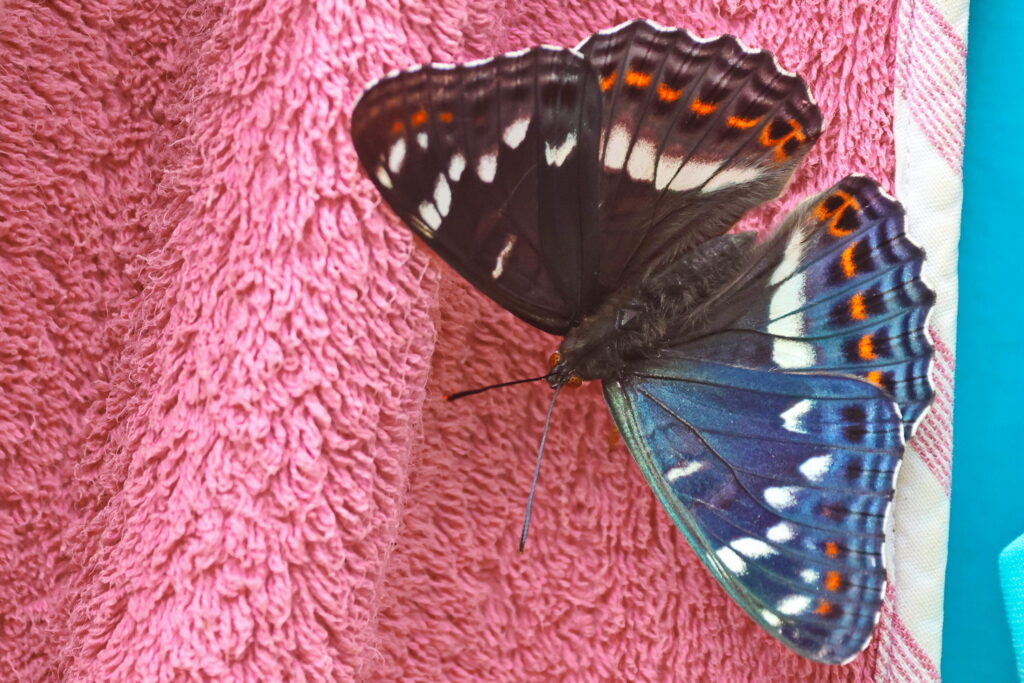
The female of the large red admiral is the largest European butterfly – and the species one of the rarest. While it shares its thirst for minerals with the red admiral, its lifestyle otherwise differs considerably.
While the Red Admiral roams widely, the Kingfisher is quite territorial. You will never see it on flowers; it feeds solely on fruit, tree sap, and especially the honeydew of aphids. The treetops are its habitat, which is significant. Females, in particular, spend practically their entire lives high up in the canopy; seeing one here in the clearing is quite a sensation.
„On hot days, especially after thunderstorms, they seek out semi-shaded forest paths in the morning to suck on wet earth or animal droppings.“ This is reported by lepidopterist Hans-Josef Weidemann, who has also dedicated himself to breeding and releasing the species, and thus, with great patience, knowledge, and intuition, has been able to establish a population for observation in his area. He also notes that areas with good humidity, such as near springs, are preferred as habitats.. (2)
Does the open diving pool represent part of an attractive habitat for him?
This fascinating butterfly requires one very specific condition for its survival: the Aspen, Populus tremula. The eggs are always and exclusively laid on the tips of exposed aspen branches. The caterpillars feed only on these leaves; there is no alternative. How fortunate that quaking aspens can be found at the forest edge and scattered throughout the surrounding woods! Several are needed, as only a few eggs are laid per tree. The connection to the Aspen is so significant and fundamental that it gave the butterfly its name: Limentitis populi refers to the poplar, Populus.
I would like to draw attention to another special feature: A blue sheen is visible in the upper part of the left wing, while the background of this strikingly beautiful butterfly otherwise appears dark brown. This “blue iridescence” is not a true color; none of the wing scales are colored.
„Its blue color is a so-called structural color, so named because it is based on the structure of the wing scales. The intricate structure of these scales alone causes the light refractions and interference phenomena that make the reflected light appear blue from a certain angle..“ (3)
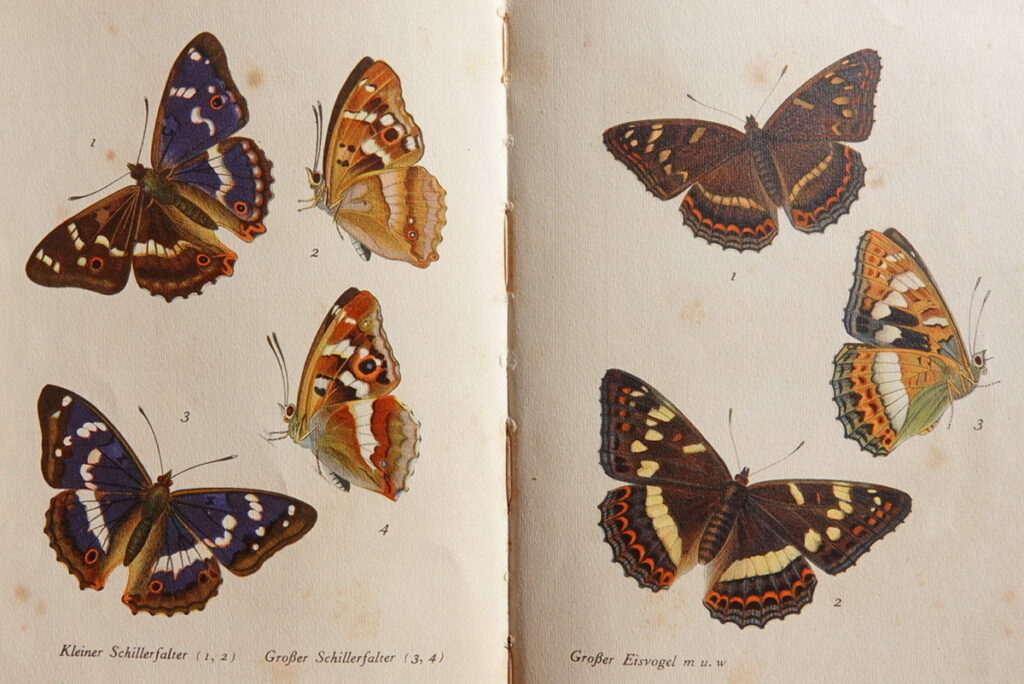
Ludwig Brandmayer refers to the purple emperor butterfly here, but the phenomenon is the same, at least in the case of the newly hatched kingfisher. The purple emperor butterfly is closely related and also loves the sweat of humans and animals.
The animals seem to enjoy the labor sacrifice of the humans.
What connections within ecology can we imagine?
Heinz Grill points out that the Earth absolutely needs human sacrifices to maintain its balance. It is human effort that, for example, balances the ratios of air and water, thereby promoting stable weather conditions.
He writes in connection with the “simplification” of life through artificial intelligence:
„The Earth, however, feels increasingly deserted due to this lack of human sacrifice, like a desert, for it lacks the physical and spiritual sweat that human striving must bring upon it every day. The air no longer receives the subtle forces of human perception in the struggle for reasoned logic and truth, and therefore it begins to experience a kind of arbitrary, self-directed emotionality.“ (5)
What is relevant here is the sphere of thought that man brings to the light through his struggle, through artistic activity, or especially through meditation.
Engaging with such a fascinating and beautiful natural phenomenon as butterflies, which leads to knowledge, awareness, connection, feeling, and appreciation, can certainly be considered, to a certain extent, a sacrifice. Such a beautiful sacrifice, made with interest and joy, so that it is hardly noticed as such!
For Naone, it’s a good thing there’s enough wood available in the meditation house for the winter!
Text: Lilly Zahara, 24.08.2026
Fotos: Martin Sinzinger
(1) Ludwig Brandmayer, Wolfgang Helfer, Till R. Lohmeyer, „Aus dem Leben der Schmetterlinge“, IHW-Verlag Eching, 2000, S. 43.
(2) Hans-Josef Weidemann, „Tagfalter“, Bd. 2: Biologie-Ökologie-Biotopschutz, Verlag Neumann-Neudamm Melsungen, 1988.
(3) Ludwig Brandmayer, Wolfgang Helfer, Till R. Lohmeyer, „Aus dem Leben der Schmetterlinge“, IHW-Verlag Eching, 2000, S. 48.
(5) Heinz Grill, „Der Himmelskampf und das Wetter“, Teil 11 des Jahresausblick auf 2025, veröffentlicht am 8. Januar 2025 unter heinz-grill.de
(6) Abbildung aus: „Das kleine Schmetterlingsbuch. Kolorierte Stiche von Jakob Hübner“, Insel-Verlag Leipzig o.J., Insel-Bücherei Nr. 213
(7) Fachliche Unterstützung durch die Internet-Seite des Vereins Lepiforum e.V.