
Vegetable growing in Naone
Generally speaking, the design of the garden and property is shaped by individual interests.
Work is done collaboratively, so the result is a joint effort by everyone.
Everyone who comes here can see what has come of their contribution.

At an elevation of just under 1,000 meters in Naone, the gardening season is drawing to a close in mid-October. Black radishes, yellow beets, winter lettuces, and vegetable dandelions still stand in the field, and a handful of pole beans will continue to enrich the kitchen. The grain has already been harvested, and the pumpkin is reaching its final stage of ripeness.
Although the field—measuring 7 by 32 meters—is not that small and is cultivated across 7 plots to ensure a healthy crop rotation, the goal is not to provide for ourselves and the participants at the free university with as large a share of vegetables as possible.
“The project is not intended to be a self-contained entity, but rather to be open, inclusive, and to foster connections. That is why we prefer to purchase the food used in our kitchen from local organic farms. The crops grown in the field are primarily for demonstration and observation.”
Grains form the basis of the diet and hold a prominent place. Every year, oats, millet, rye, barley, and spelt are cultivated. Germination, growth, flowering, fruit formation, and ripening can be observed and experienced firsthand. Through spiritual exercises, the initial impressions gathered in passing are deepened, fostering a more intense connection. Life forces or etheric forces are generated and have a constructive effect on nature and humanity.


It is striking that the plants thrive on small rows of mounds that have also been arranged in arcs. Why was this particular form of cultivation chosen?
In general terms, Heinz Grill discusses how structured forms stimulate plant growth. Rudolf Steiner stated that living etheric forces are at work at an elevated level. To put these spiritual insights into practice, the “embankment cultivation” method developed by Julian and David Turiel was adopted in Naone. In horticulture, this cultivation method ensures that water, air, and warmth reach the plants under particularly favorable conditions.
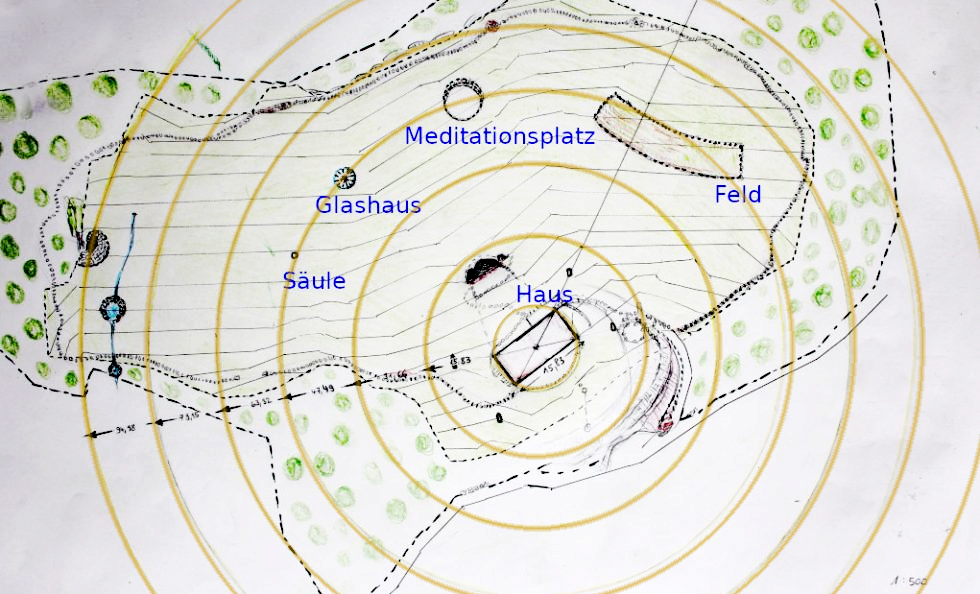
Turiel, however, makes no mention of arched forms; these are a distinctive feature of Naone. The arches and mounds are arranged so that they converge on the “Casa artistica.” The entire layout of the garden or field is oriented toward the house and arranged concentrically around it in the shape of a circular segment.


One could say, then, that the garden was developed from the center of the house in two ways: through specific, concrete, deliberate, and imaginative ideas—such as those cultivated in academic study—and through geometric design. The cultivation of the garden is based on ideas about the constructive development of vegetables, people, nature, and the world. Through the rhythmic collaboration of interested people, subtle relationships develop among them.
Lilly Zahara, 26.10.2025
Landscape Design:
The Seven Circles Around the Center of the House
A total of 7 circles were measured around the house, all of which have the center of the house as their center and are spaced one house length (15.83 m) apart. Various features on the property are thus oriented toward the center of the house, such as the circular meditation area, the glasshouse, and the column.
These features all lie on the same arc. This creates a basic geometric framework for the entire property. The house and its various elements form a cohesive whole.
“Wenn nämlich für irgendeinen Ort der Erde ein Niveau, das Obere der Erde, vom Inneren der Erde sich abgrenzt, so wird alles dasjenige, was sich über diesem normalen Niveau einer bestimmten Gegend erhebt, eine besondere Neigung zeigen zum Lebendigen, eine besondere Neigung zeigen, sich mit Ätherisch-Lebendigem zu durchdringen. Sie werden es daher leichter haben, gewöhnliche Erde, unorganische, mineralische Erde, fruchtbar zu durchdringen mit humusartiger Substanz oder überhaupt mit einer in Zersetzung begriffenen Abfallsubstanz, wenn Sie Erdhügel aufrichten und diese damit durchdringen. Dann wird das Erdige selber die Tendenz bekommen, innerlich lebendig, pflanzenverwandt zu werden.“
Rudolf Steiner, “Geisteswissenschaftliche Grundlagen zum Gedeihen der Landwirtschaft” (Landwirtschaftlicher Kurs”, Vierter Vortrag, Koberwitz, 12. Juni 1924


Die von Julian Turiel entwickelte “Turiel-Dammkultur” versteht sich als ganzheitliches Anbausystem.
Ziel ist es, Böden aufzubauen. In der traditionellen Dammkultur gilt es daher Bodenleben zu fördern, dass sich Pflanzengesundheit und Erträge nachhaltig steigern.
Link zur Website (Foto siehe turiel-dammkultur.com)