
The Apple:
Light, imagination, and a feeling for the earth

Bowls of fresh apples are available for guests at the Sonnenoase Lundo and visitors to the “Casa artistica di Barbara” seminar house in Naone. A seminar in the “Spiritual Vision” course held in early October 2026 focused on food; bread and fruit were the main topics. Now, in the fall, the apple is one of the most important fruits that can, of course, be enjoyed fresh.
Heinz Grill attributes a special significance to the apple, both for human health and for human development. It awakens a person’s powers of imagination, he writes, for example. And further: it
„Through its gentle cleansing effect, it gives him a better sense of the earth and his homeland.“ (0)
Reason enough to take a closer look at the apple.
The apple and its relatives
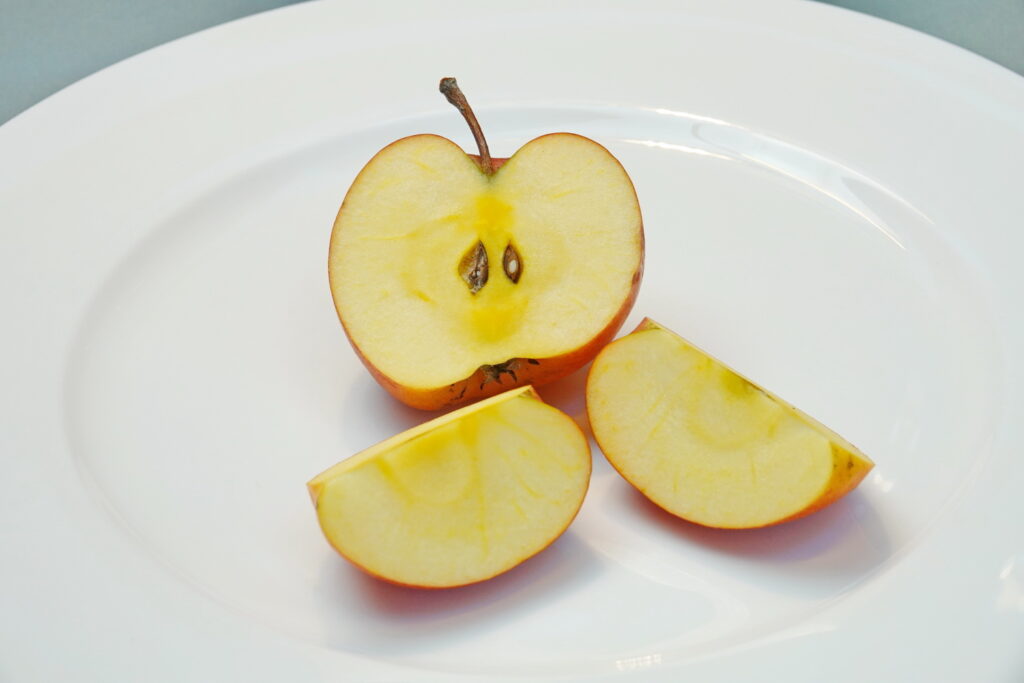
Like the pear and the quince, as well as the medlar and the rowan, the apple is classified as a pome fruit. The term “pome fruit” is self-explanatory, since everyone is familiar with apple seeds from personal experience. The viable apple seed is the actual seed. Each apple usually contains five such seeds—though not directly in the flesh, but loosely arranged in the core. Each seed develops in its own seed chamber, so that five chambers form the core—colloquially known as the “core” or, botanically, the “aggregate.” If the seeds represent the actual seeds, then the aromatic apple that we so greatly appreciate for eating is actually a false fruit—in this case, the swollen and developed former receptacle.
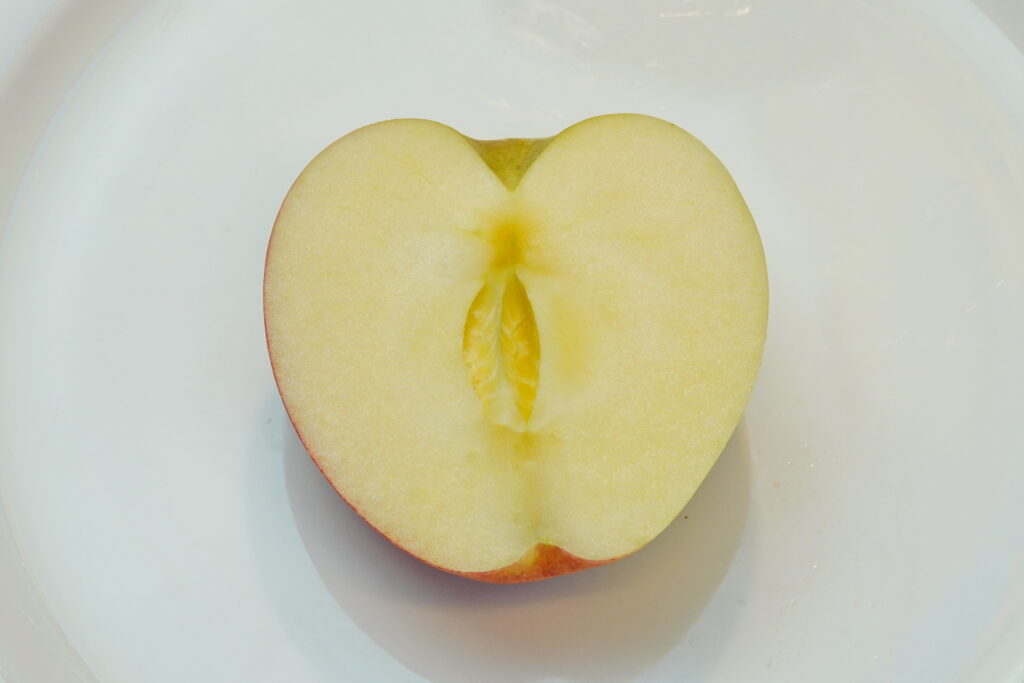
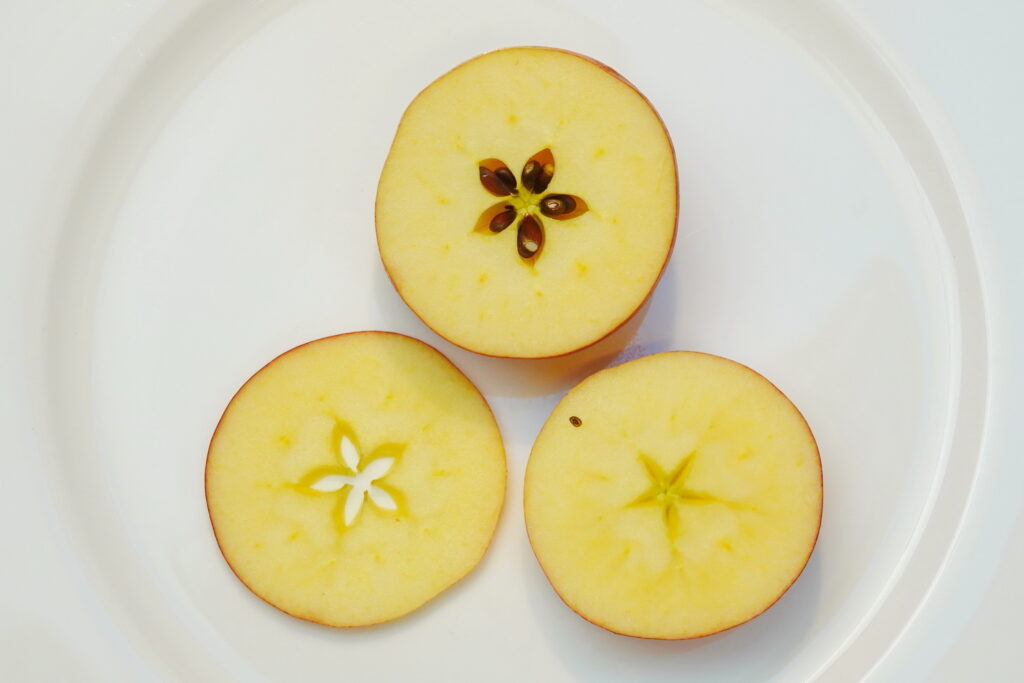
Heinz Grill, Meditationsbrief 265
The number five—five sepals and five petals, or a multiple thereof—classifies the apple as part of the large family of Rosaceae. The renowned botanist Wilhelm Pelikan offers a description that, at first glance, is not entirely straightforward but is very vivid.
„The stamens grow on a common receptacle, which is flat and domed but usually inverted; it encloses the developing seeds like a second shell and, charged with the sprouting, vegetative forces from the region below the flower, swells into a fleshy structure, partially fusing the carpels and sepals together and thereby producing the juicy berries and false fruits.“ (1)
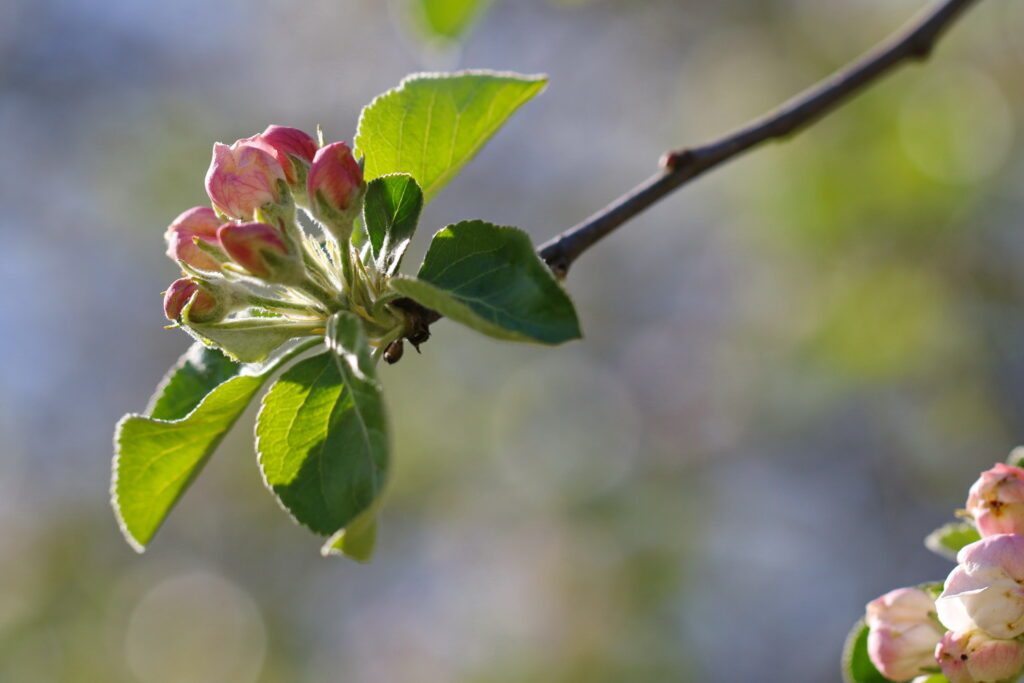
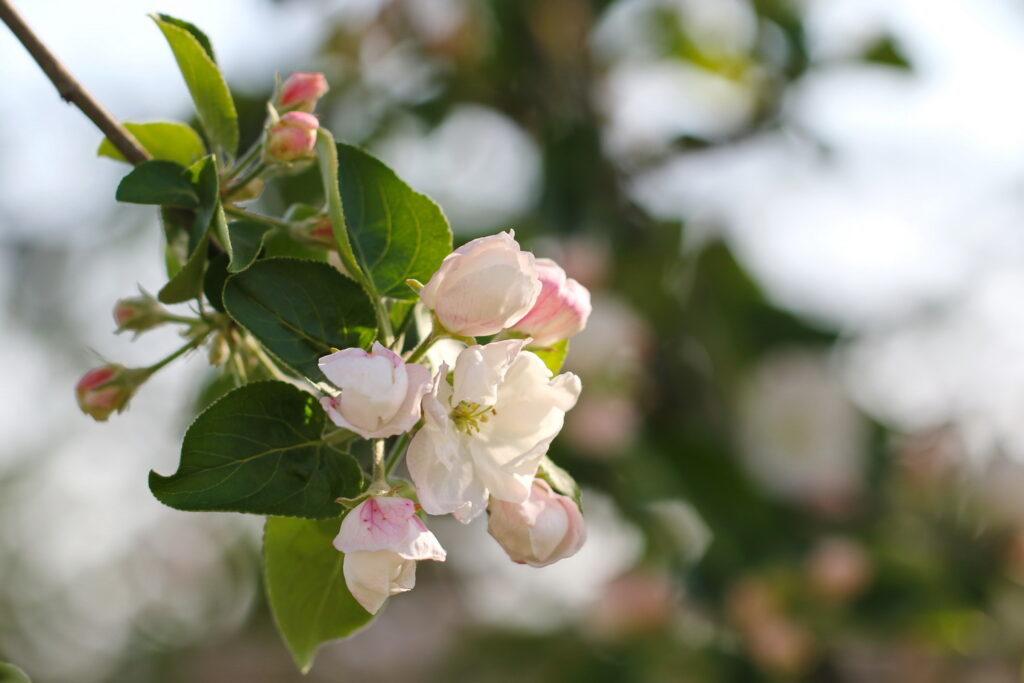
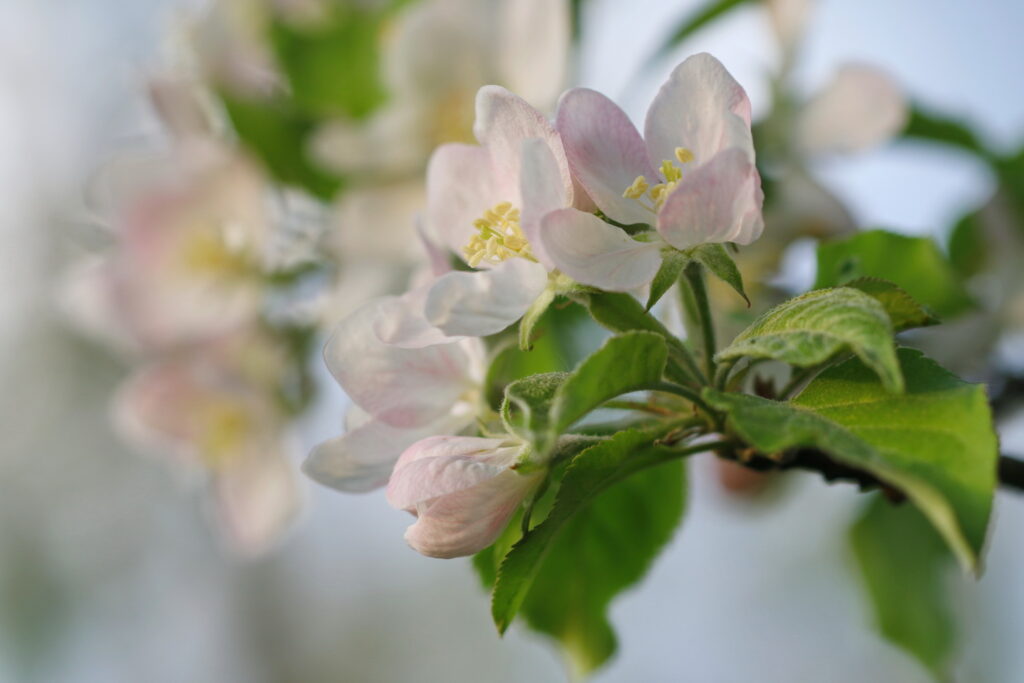
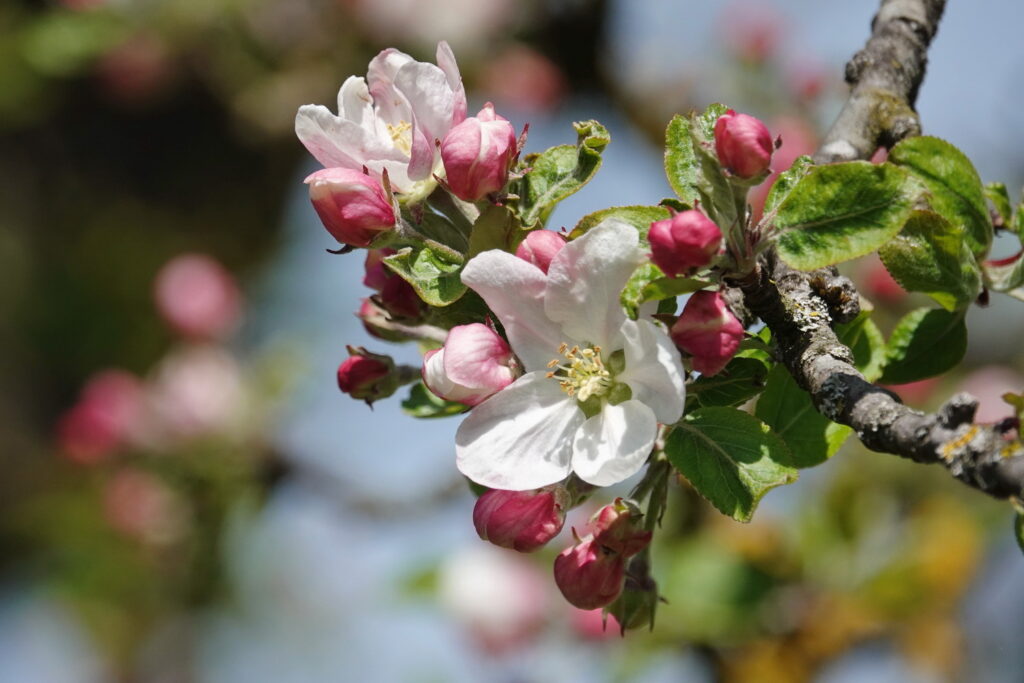
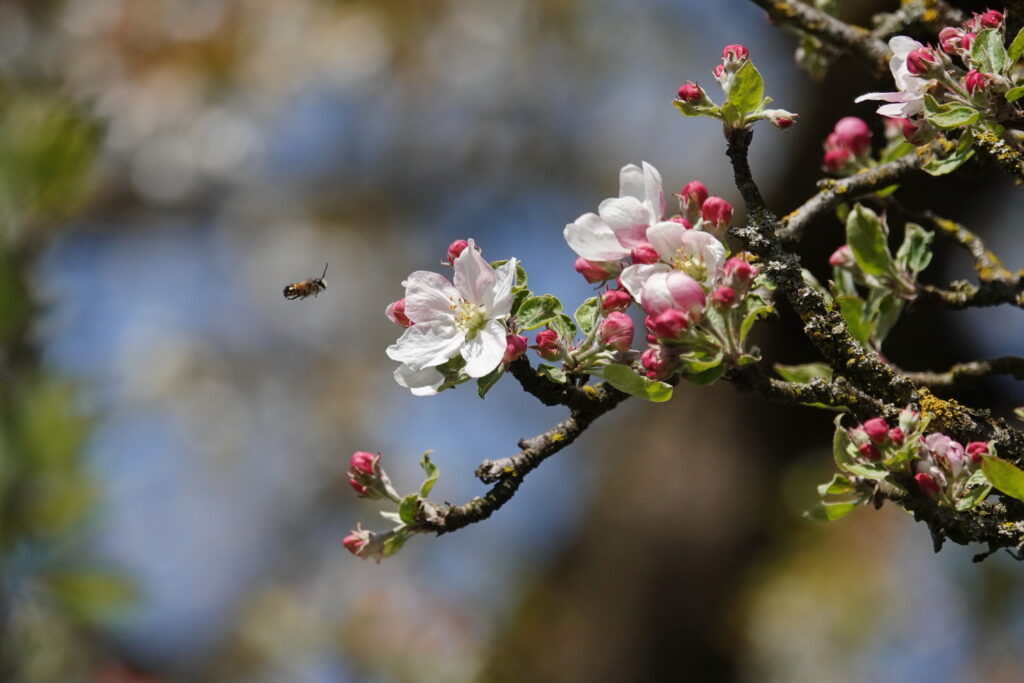
We must not fail to mention the beautiful blossoms that adorn the trees with a splendor of white tinged with pink. In addition to the cultivated apple, there are specialized varieties of ornamental apples that are prized in gardens and parks for their abundant spring blooms and colorful fall fruit. These fruits range in size from a cherry to a walnut; while edible, they have a tart, sour flavor.

A Brief Cultural History of the Apple
Both the Eurasian and American continents are home to wild apple varieties that are collectively referred to as “wood apples” or “crab apples.” American wild apples bear small, tart, sour, or even bitter fruits; they form the basis for most ornamental apple cultivars. However, even the European crabapple species are a far cry from today’s cultivated apples. Not only do they lack the tasty, large, well-formed fruits; the wild species also reach only six to eight meters in height and have a rather shrubby, bushy growth habit.
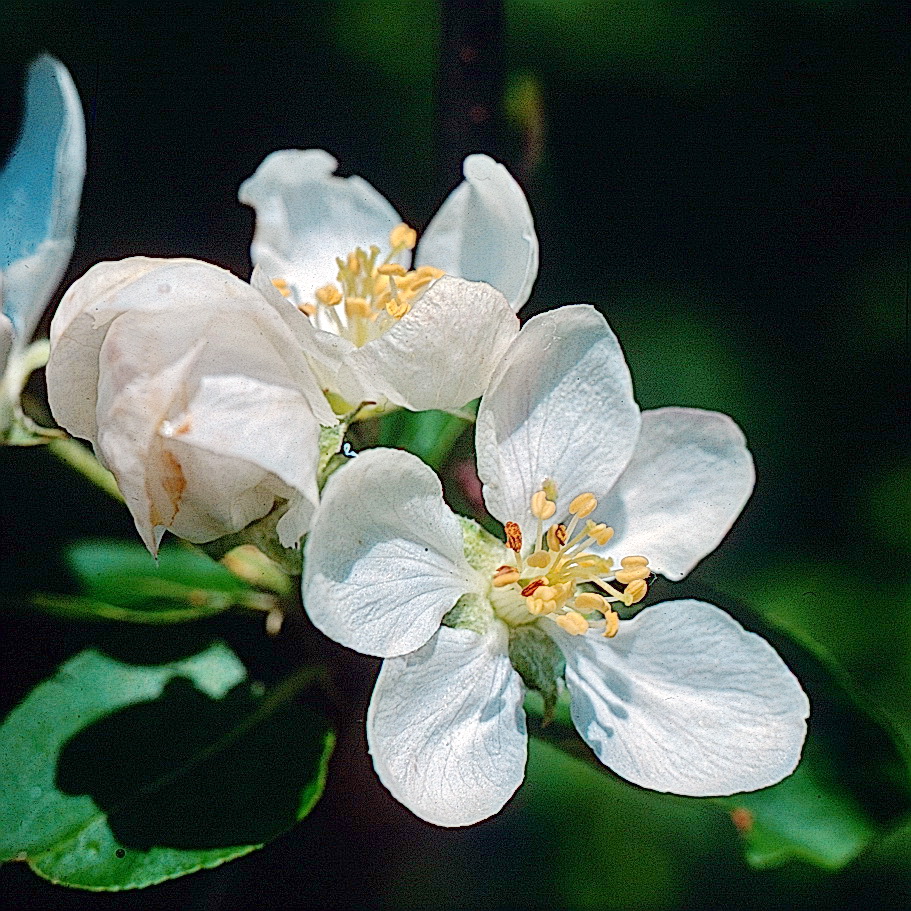
In the crab apple, Edward Bach discovered a valuable remedy, which he characterizes as follows:
„This is a cleansing remedy. It is for those who feel that there is something not quite pure about themselves. […] As a cleansing remedy, this medicine can also cleanse wounds if the patient has reason to believe that toxins have entered the body and need to be removed.“ (5)
The cultivated apple itself has a long history in Europe—it was prized in ancient Greece as well as in ancient Rome. It is believed that the apple spread to Central Europe with the Romans. However, this does not yet shed light on the question of its origin.
Today, its origin is thought to lie in a region far to the east, in the Tian Shan Mountains in what is now southern Kazakhstan. The extensive wild apple forests there exhibit immense diversity, including sweet varieties and those that rival our cultivated apple in size and taste. Here, the apple trees reach an impressive size and can live up to 300 years. Supported by genetic analyses, the current scientific theory is gaining traction: that all cultivated apple varieties worldwide—numbering over 6,000—ultimately trace their origins to Central Asia.
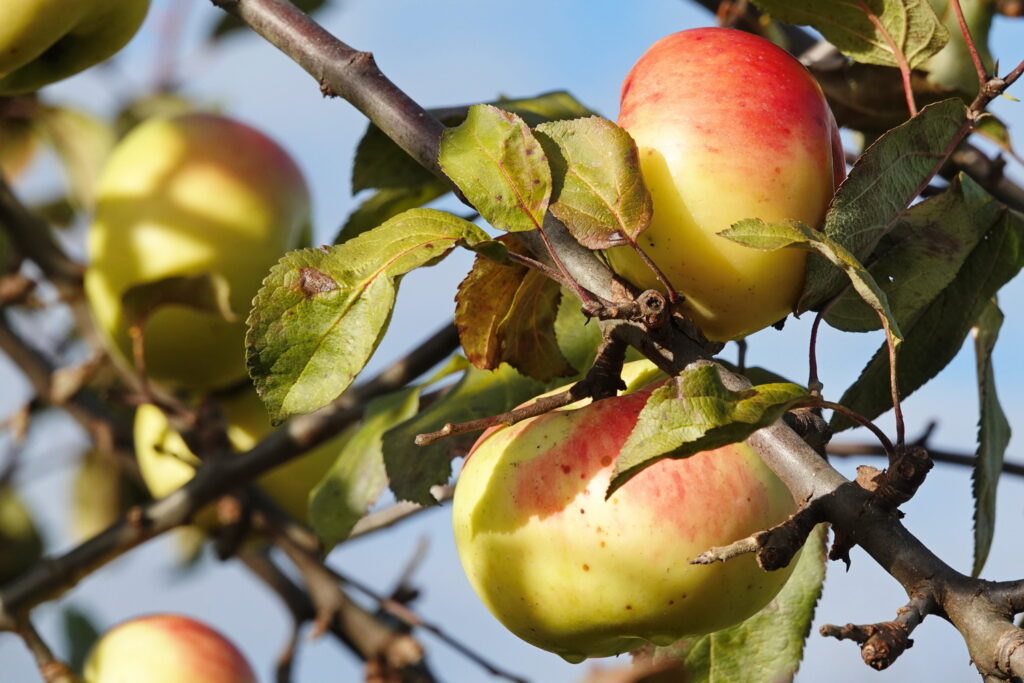
While cultivated apples were already documented 6,000 years ago in the region around Alma-Ata (meaning “Grandfather of Apples” in German; today Almaty, the former capital and still the largest city in Kazakhstan), it is considered a certainty that apples were already being cultivated in the Caucasus and the Middle East 4,000 years ago. When trying to visualize the spread of the apple tree, it’s also important to consider that varieties can be propagated and disseminated not only through seeds but also through grafting. A scion from a desired apple variety is grafted onto a branch of a rootstock. The tree will then develop its canopy according to the grafted scion and bear fruit accordingly. The Sumerians, for example, had mastered this cultivation technique 7,000 years ago, so that their civilization also made the Middle East an important hub for the migration of the Central Asian apple to Europe. (4)
The Significance of the Tree
It is significant that apples—like other fruit—grow on trees, and are thus lifted, to some extent, from the ground—from the earth—up toward the sky.
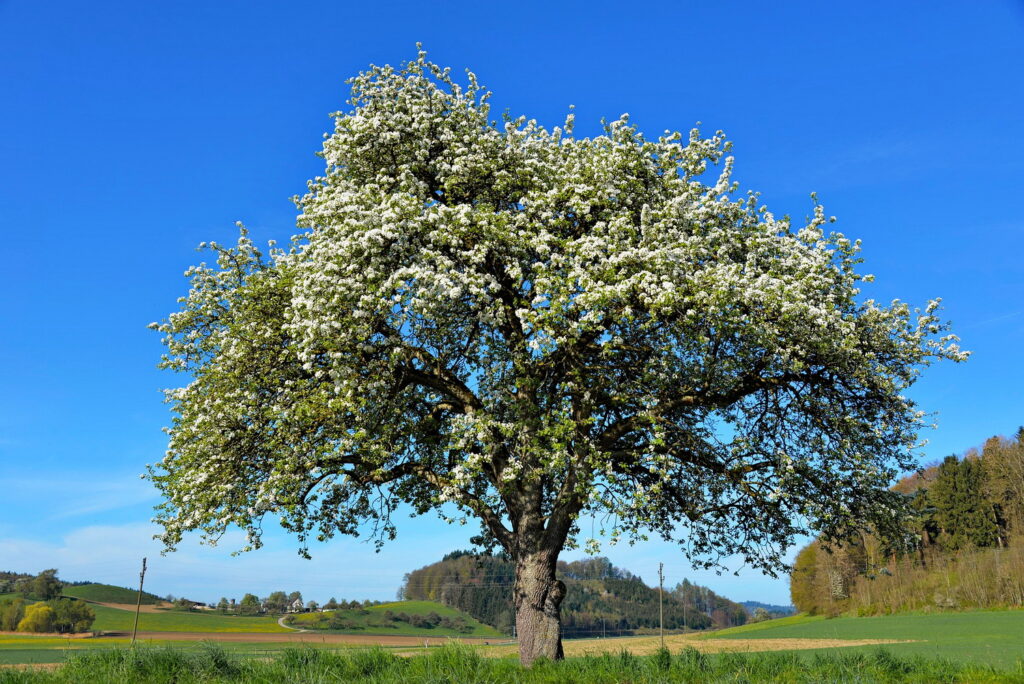
Heinz Grill writes on this subject:
„Just as with grains, fruit contains a great deal of light energy. Cosmic life approaches fruit trees in a very special way, with a broad and enveloping radiation. The fruits are charged by the intense light effects of cosmic forces“ (6)
It should merely be suggested here that the hardening of a plant into a woody stem—if one follows Rudolf Steiner—is of truly decisive significance.:
“The plant world is the soul of the Earth made visible. […] Is it not as if the Earth had forced its way out through its own power, just as if its innermost essence had forced its way out through the tree into outer space, upward, only to develop its blossoms and fruits out there?” (7)
„An apple a day …“
This proverb is so well known that it does not need to be completed. Regarding its general health value, Gunter Steinbach, for example, notes:
“As is well known, you can never get tired of eating apples. Not only do they taste good, but they’re also healthy. In addition to invert sugar and malic acid, apples contain small amounts of protein and fat, vitamins A (carotene) and C, various B vitamins, enzymes, tannins, pectin, and trace elements such as calcium, potassium, iron, and phosphorus.”
Das Heilpflanzenlexikon von Dr. Hauschka gibt an: “Reich an Vitaminen, insbesondere Provitamin A, B1, B2, B6, C und E; Mineralstoffe wie Kalium, Eisen, Kalzium und Zink; Spurenelemente, Ballaststoffe, Antioxidantien, Polyphenole und Flavonoide; organische Säuren. 75 Prozent der Inhaltsstoffe sitzen in oder direkt unter der Apfelschale.” (8)
In the past, cooked applesauce was commonly given to infants as their first food after breast milk. Apples act as a mild regulator for digestive disturbances and were valued as a home remedy for both diarrhea and constipation. (9)
To define the benefits of the apple more specifically, we can also refer to Heinz Grill, who notes that it is an excellent remedy for problems within the digestive tract.
„Thanks to its pectin and gel-forming compounds, it has a detoxifying effect on the digestive tract. Eating one apple a day can help prevent certain stomach and intestinal disorders. Apples are most effective at cleansing the body when they are chewed thoroughly or eaten finely grated.“ (10)
Ursel Bühring provides a detailed description of the processes triggered in the intestine by the intake of apple pectin. She confirms the adsorption and excretion of toxins and pathogens by glacturonic acids, a breakdown product of apple pectin. (11) Furthermore, Heinz Grill attests to relief and cleansing of the bile ducts and liver, as well as stimulation of urine production and excretion. (12)
What strikes me as remarkable about Heinz Grill’s statements is that they describe metabolic processes precisely and in detail, but subsequently develop more subtle, sensory characteristics. The person feels refreshed and alertness increases
. (10)
„At the same time, the pectin in apples affects the gut flora by absorbing toxins. As the apple absorbs these toxins that form in the gut flora, those who eat a sufficient amount of apples develop a special and deeper connection to the earth.“ (13)
The quote mentioned at the beginning, with which Heinz Grill establishes a connection between gentle cleansing and a person’s inner, soulful experience, is worth repeating here.:
„In particular, eating apples stimulates the imagination and, through their gentle cleansing effect, gives people a deeper sense of connection to the earth and their homeland.“ (10)
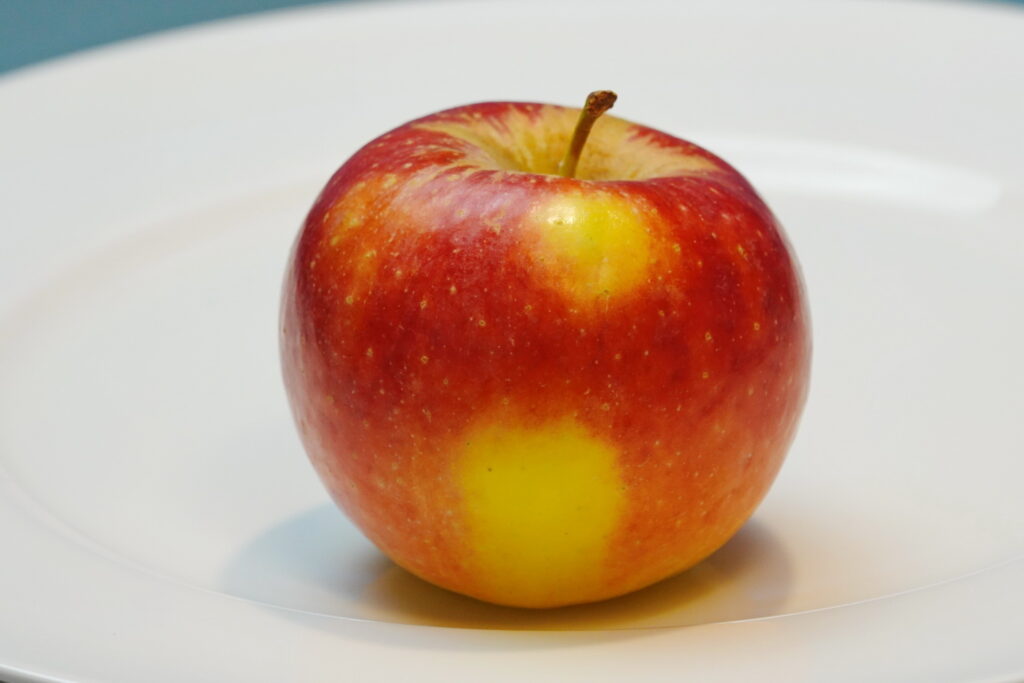
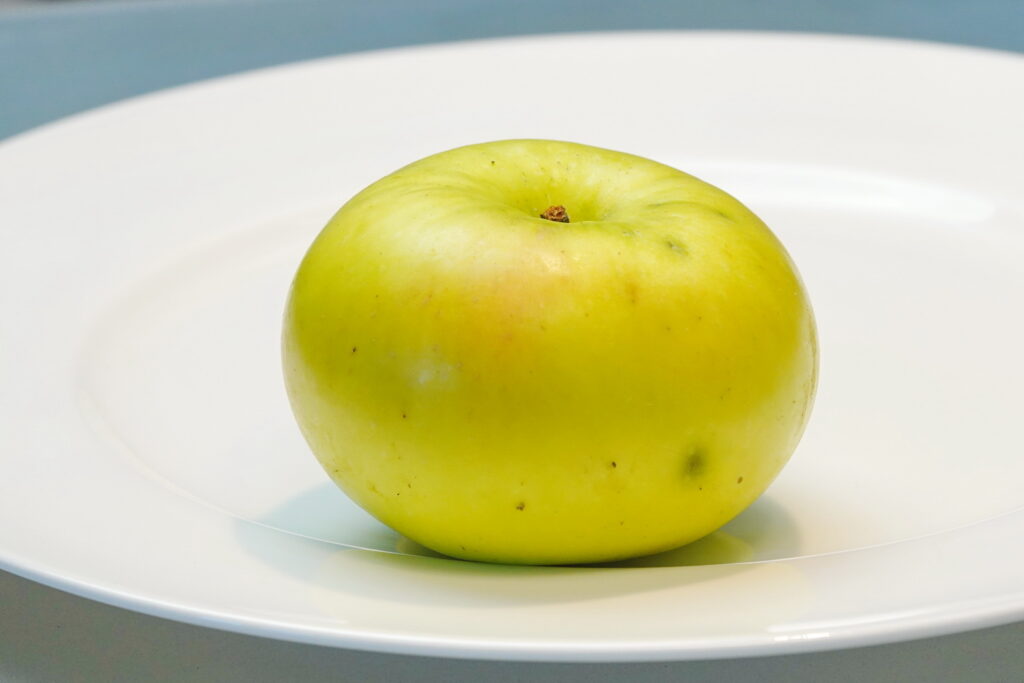
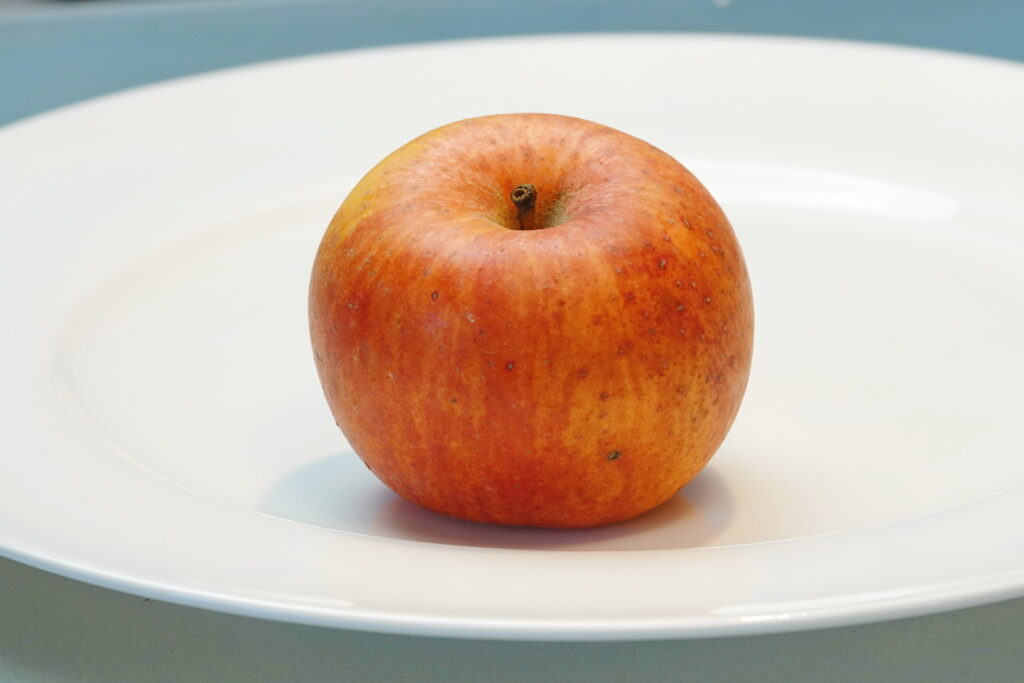
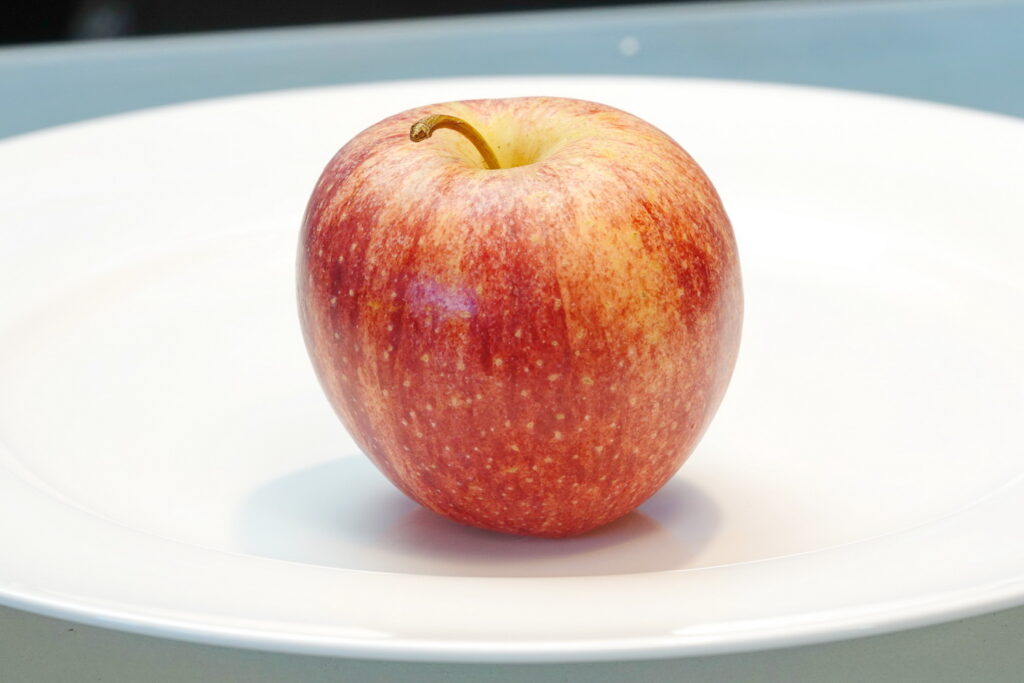
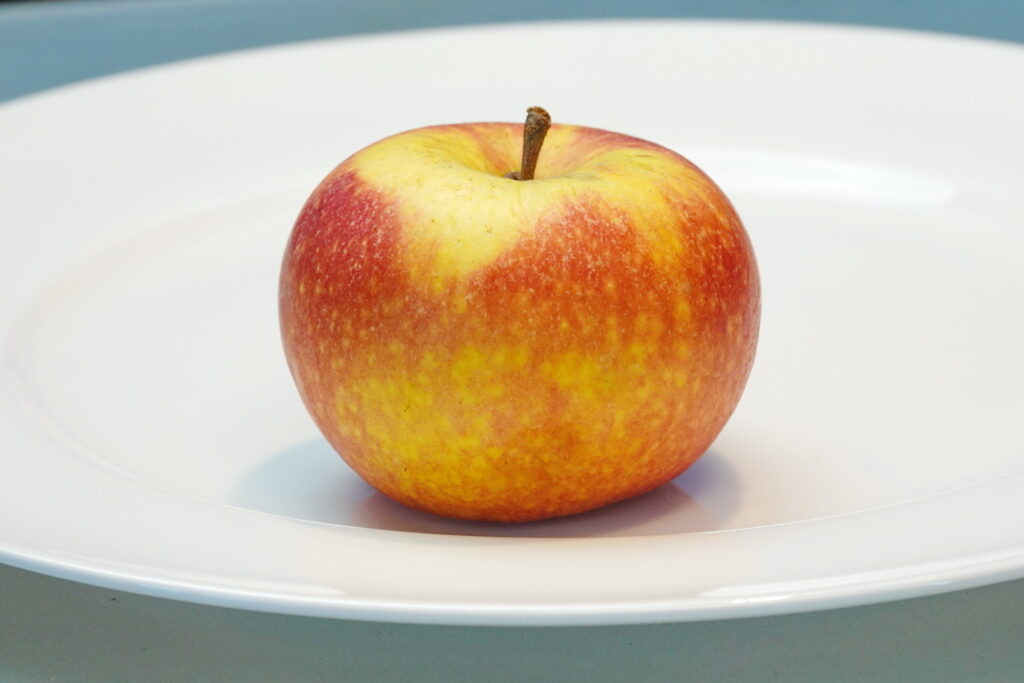

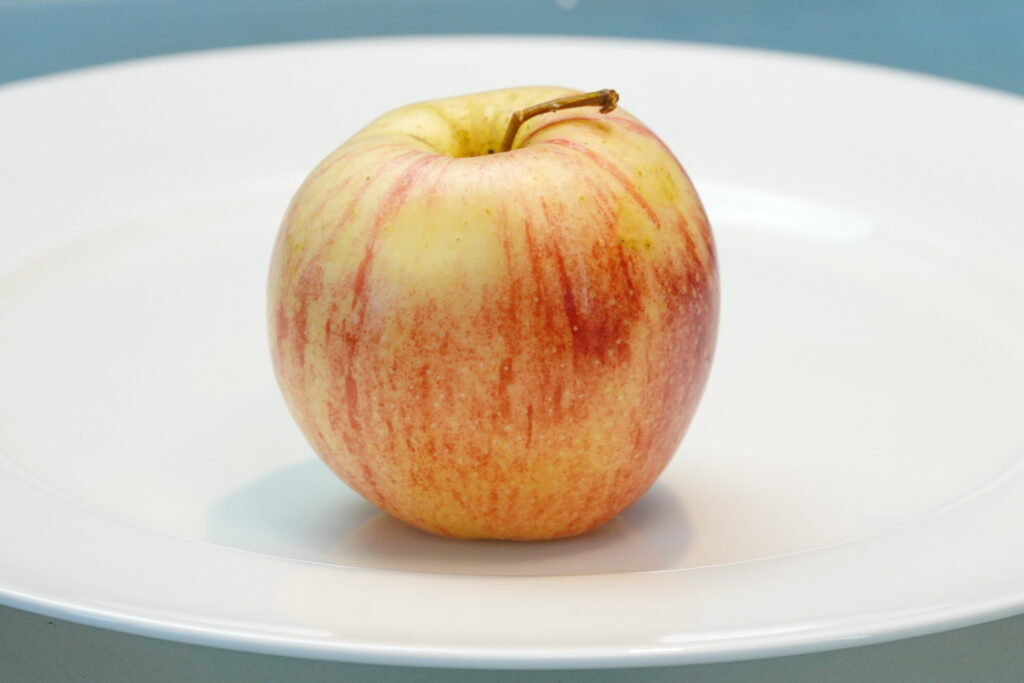

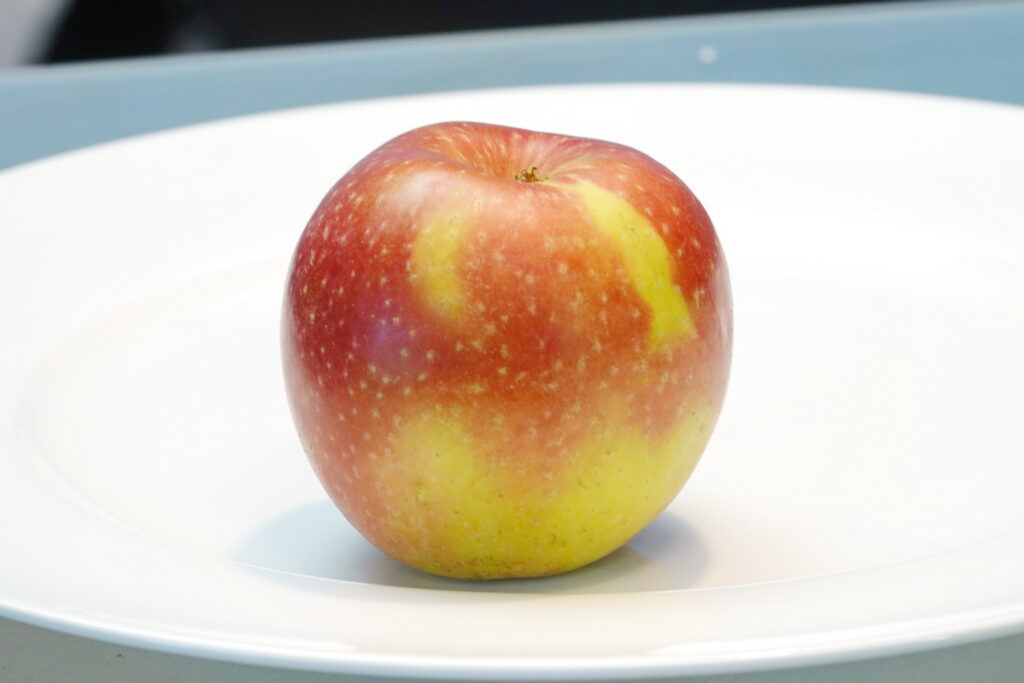
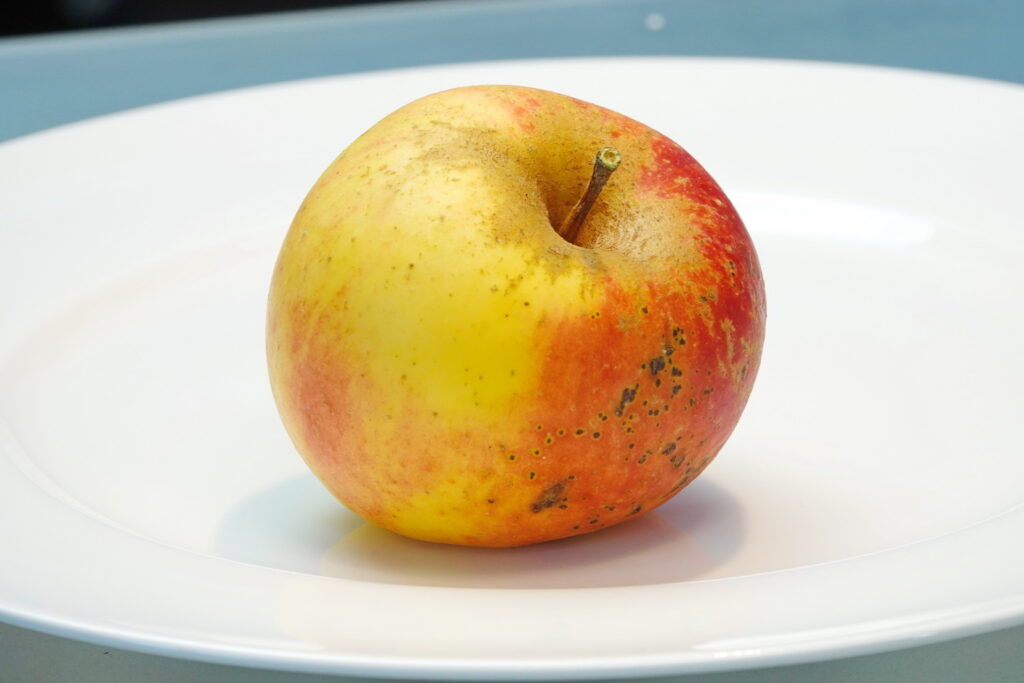
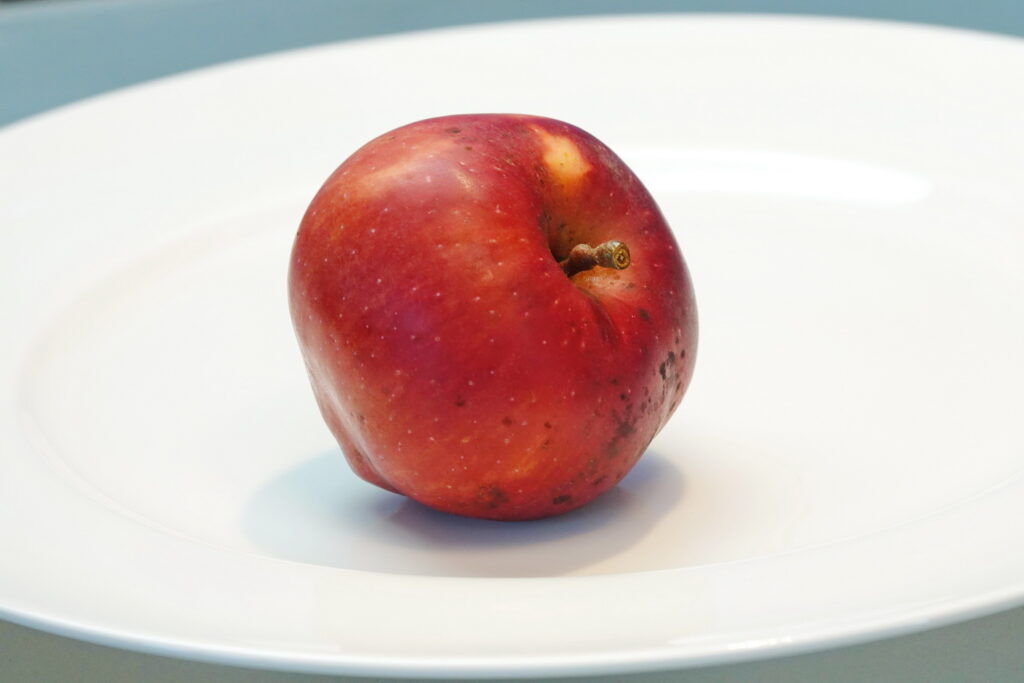

It is soft and gently enveloping, without enveloping the viewer, almost as if it were protective.”
Heinz Grill, Meditationsbrief 263 vom 24. Oktober 2024
When people say, “An apple a day…,” and imagine a full year of 365 days, it’s important to realize that before the age of global logistics, supportive cultivation techniques, and supply chains, it wasn’t a given that a single type of fruit would be available all year round. And this is where another characteristic of the apple—and the horticultural achievements of past centuries—comes into play, because it is actually possible to enjoy apples from your own garden all year round.
The early apple—also known as the “Klara apple” or “oat apple”—is the first to ripen each year, just as the oats are ready for harvest, which is in July. Throughout the summer, a wide variety of table apple varieties are ready for immediate consumption.
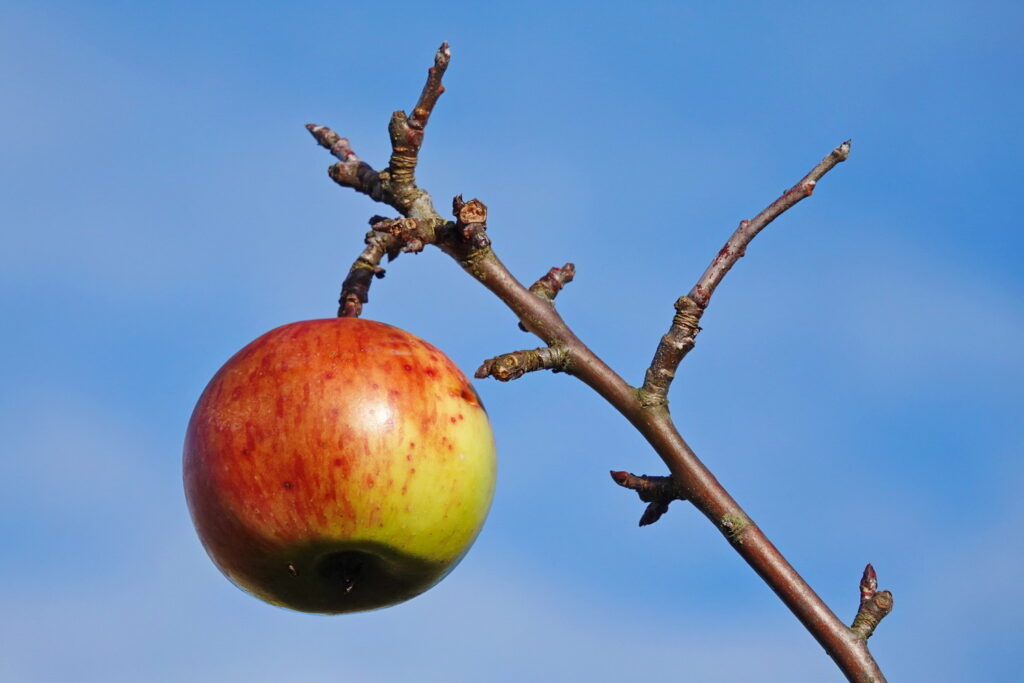
Things get exciting in the fall with the harvest of winter apples—that is, the varieties that keep well. When picked in the fall, these apples are still unripe, hard, and taste tart and grassy. A balanced flavor and an aroma characteristic of the variety only develop after several weeks of ripening.
„An apple, once picked and placed in a fruit bowl, remains alive. It breathes, excretes, and ages. Metabolic processes within apples and pears continue even after harvest: starch is converted into sugar, acids break down, and aromatic compounds develop. The fruits release water and various gases—such as carbon dioxide, volatile organic compounds, and ethylene—into their surroundings.“ (14)
Many varieties—most of which have largely been forgotten today—can be stored and enjoyed until March or April of the following year, and some even until May or June.
The discussion now turned to health, with little mention of the wonderful aroma, the fragrance, and the sweetness that make the apple so appealing. The production of sugar is a characteristic of the rose family; Wilhelm Pelikan points out that this precious substance is formed exclusively in those parts of the plant that the plant itself does not utilize further, but rather relinquishes.
„The Rosaceae exhibit a hypertrophic sugar-production process that enables them to produce abundant sugary sap, which they use to swell their sweet berries or juicy, aromatic fruits. Through this hypertrophic sugar-production process, the Rosaceae have become the largest fruit-bearing family in the temperate zone, with no other plant family coming close to matching them in this regard. […] The ability to produce sugar to a remarkable degree is thus one of the most striking characteristics of this group. To fully appreciate this characteristic, one must realize that the sugar produced in this way has no further significance for the plant once it has been secreted and flows out into the external environment; it is lost along with the falling ripe fruit, which, as it rots, releases the seeds. The rose family is active in sugar production; the fully formed sugar substance is then of no further significance to the plant itself.“ (15)

Light, imagination, and a feeling for the earth
Up to this point, most of the statements in the article can be readily derived and understood through analysis and research. A qualitative leap—one that transcends the level of analysis and aims holistically at the very essence of the apple—occurs through imaginative contemplation and inquiry, or by posing questions that point toward this as-yet-unknown realm. The mental image acquired through engagement with the phenomenon can serve as a consolidating foundation for this process of gaining insight; yet, as one moves toward an essential understanding, all of this ultimately recedes into the background.. (16)
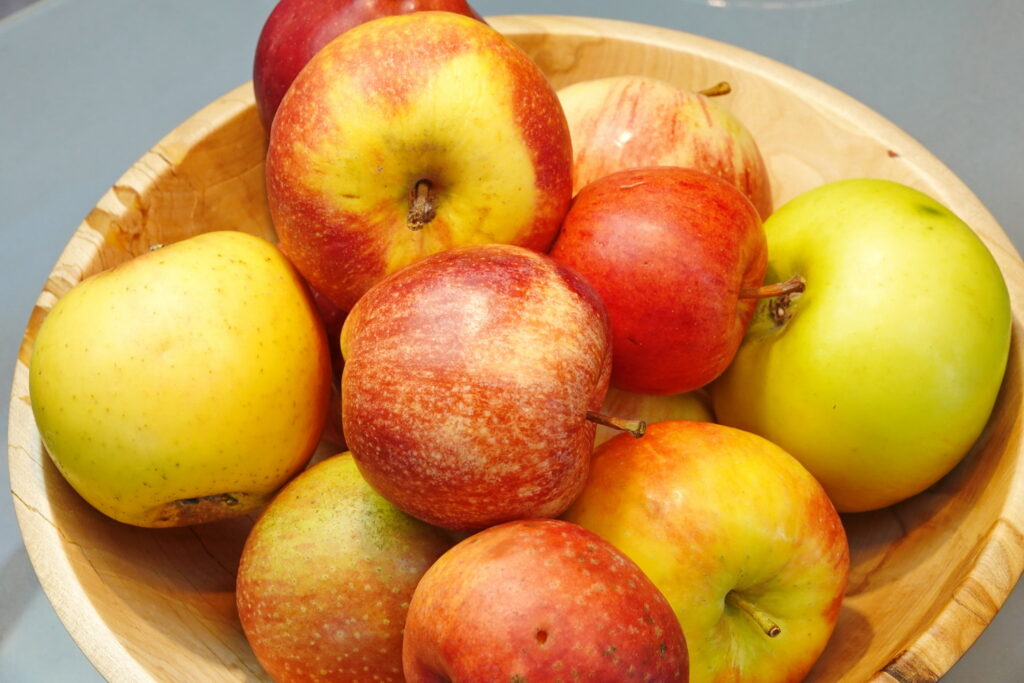
„If someone were to pose a riddle, placing various apple varieties before a group and asking which varieties they are and what they are called, the group would have to consult a natural history encyclopedia or another relevant reference book to look up the names. However, they cannot discover the quality of the apple in terms of light or its inner essence in a reference work. This insight must be acquired through practice by training the spiritual faculties and through object-oriented concentration..“ (17)
Meditationsbrief 265
For example, research questions that Heinz Grill had formulated for the meditation letters in the autumn of 2024 were as follows::
„What is the light within an apple like? How can it be described, perceived, and experienced in relation to the human soul’s existence?“
„How does ethereal light affect human physiology, and what health-related effects can be expected?“
The statements cited below relate to this type of research in the humanities. The images and ideas can enrich and expand one’s own experiences and perceptions.
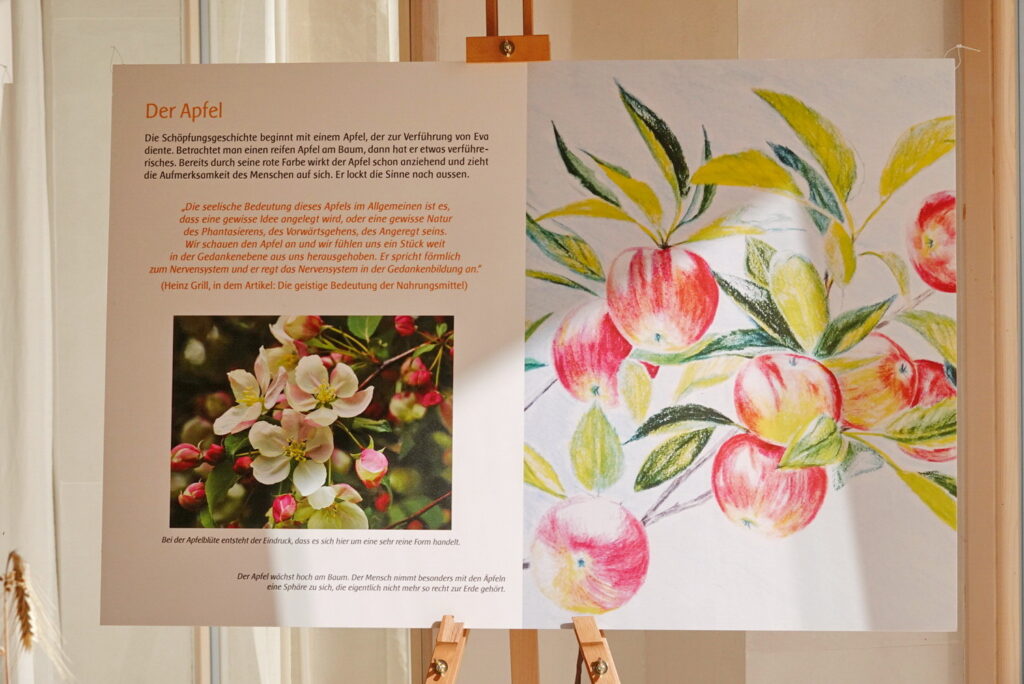
„The psychological significance of this apple in general is that it instills a certain idea, or a certain disposition toward imagination, moving forward, and being inspired. We look at the apple and feel, to some extent, lifted out of ourselves on the level of thought. It literally speaks to the nervous system and stimulates it to form thoughts..“ (18)
The grain and the fruit
Virtues and spiritual qualities require substantial physical strength in order to flourish. Accordingly, nutrition plays a vital role in supporting life and steering it in a certain direction. (19) The conscious selection and combination of foods therefore also influences a person’s moral development.
In this sense, grains and fruit can be viewed, to a certain extent, as antipodes—or as complementary, stabilizing factors—within one’s diet.
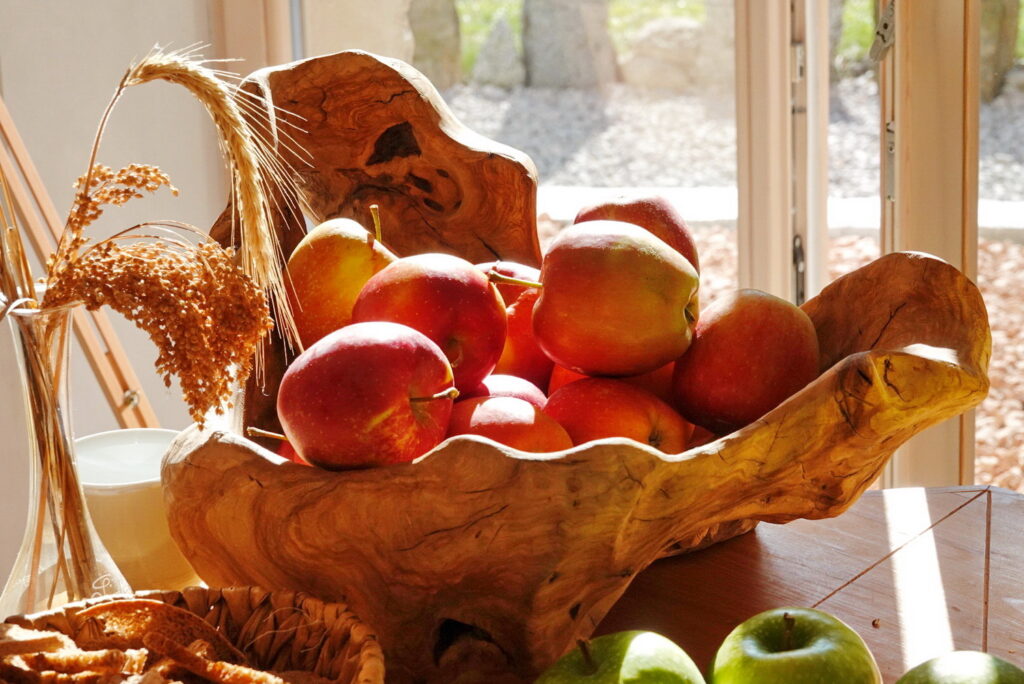
„When people eat tree fruits, they generally take in a sphere that no longer truly belongs to the earth. A more distant cosmic impulse lives within them; yet those who eat fruit do not merely draw in the abundance of strength needed for giving and realizing their potential—they open their eyes and yearn for the goal of life. That great ideal of being human becomes visible to them, and they gain the confidence that a life in a more ideal and higher sense truly exists. Grains provide the strength for life; fruit bestows the idea and longing for something higher. One senses and desires to attain the goal of life in the sense of an ideal. A focus on new longings is stimulated. Fruit plays an important role in spiritual and mental development. […] Fruit and grain complement each other to form truly substantial nourishment—both physical and spiritual. Fruit brings the ideas; grain brings the strength to realize them.“ (20)
In this sense, the aforementioned seminar encompassed the two major impulses of natural nutrition.(21)
Preparation and Digestibility
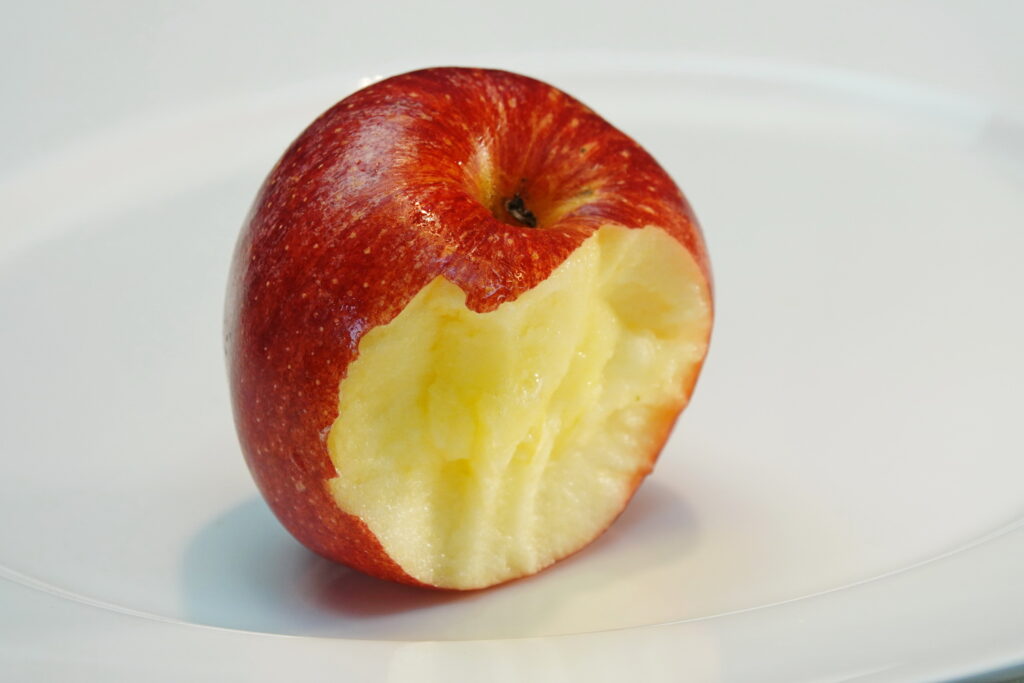


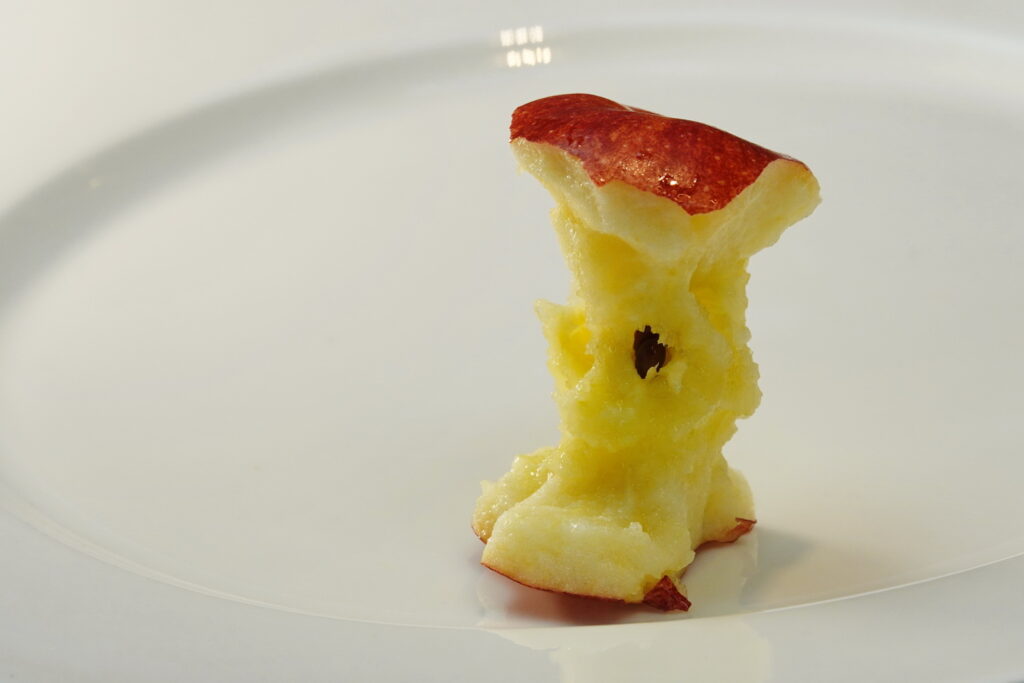

Cooked apples are considered particularly easy to digest. However, even when eaten raw, the way an apple is served makes a difference. Ilona Kramhöller reports from the aforementioned seminar on “Spiritual Vision,” held on October 3–4, 2026:
“There is a difference between eating an apple whole and eating it cut into lengthwise and crosswise slices. Heinz Grill cut an apple into many slices and said that this makes the apple more accessible. He asked the question: “What happens when the apple is cut?”
By cutting, humans shape and form, thereby bringing about differentiation. The sliced apple draws closer to the human, while the whole apple remains more closely connected to the forces of nature. When cut into slices, the apple becomes more accessible to consciousness, the senses, and the metabolism. You may have noticed that it is easier to digest a sliced apple than when you take a bite out of a whole apple. Through intense contemplation, one draws closer to and connects with the etheric forces, allowing the healing effects hidden within to be released more intensely.” (22)
The delicate nature of the apple
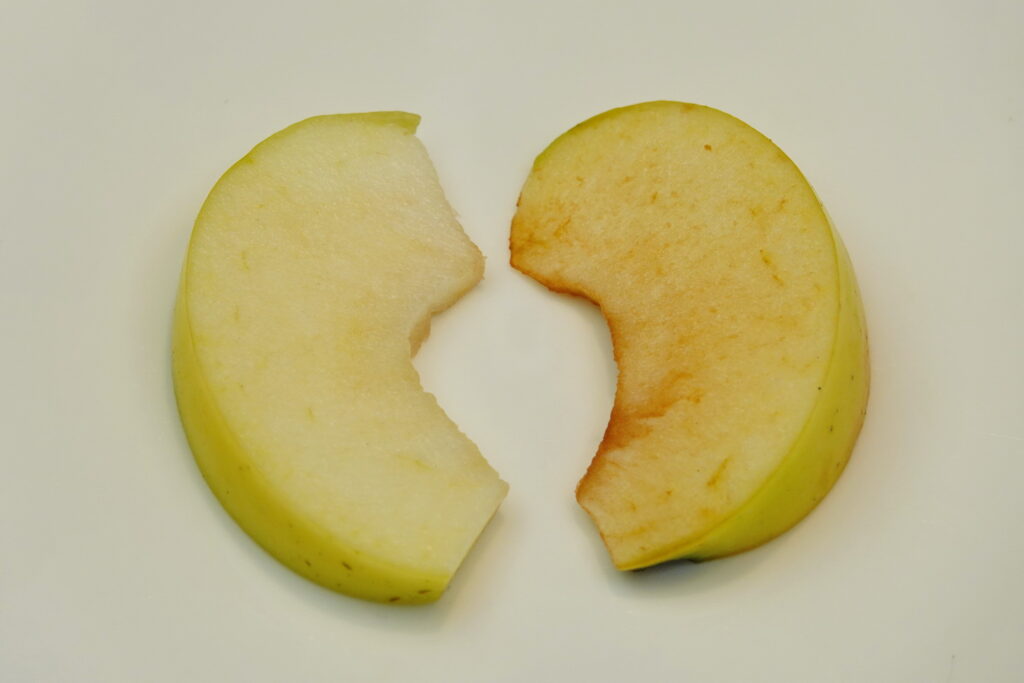
Heinz Grill describes on several occasions that, upon contact with the air, the apple takes on a “delicate character.”
Even though this statement—which refers to a sensory quality derived from spiritual research—cannot be fully explained on a material level, I would nevertheless like to point out the everyday observation that the apple reacts very sensitively to air and light.
Depending on the variety, an apple turns brown to a greater or lesser extent as soon as it is cut open and comes into contact with air. From a physical standpoint, secondary plant compounds (polyphenols) react with oxygen under the influence of certain enzymes to form melanin. The faster an apple turns brown, the more melanin is produced, which is an indicator of a high concentration of polyphenols with strong antioxidant properties.
Polyphenols are associated with a reduced risk of chronic diseases—including cancer, cardiovascular disease, high blood pressure, high cholesterol, and inflammation. (23)
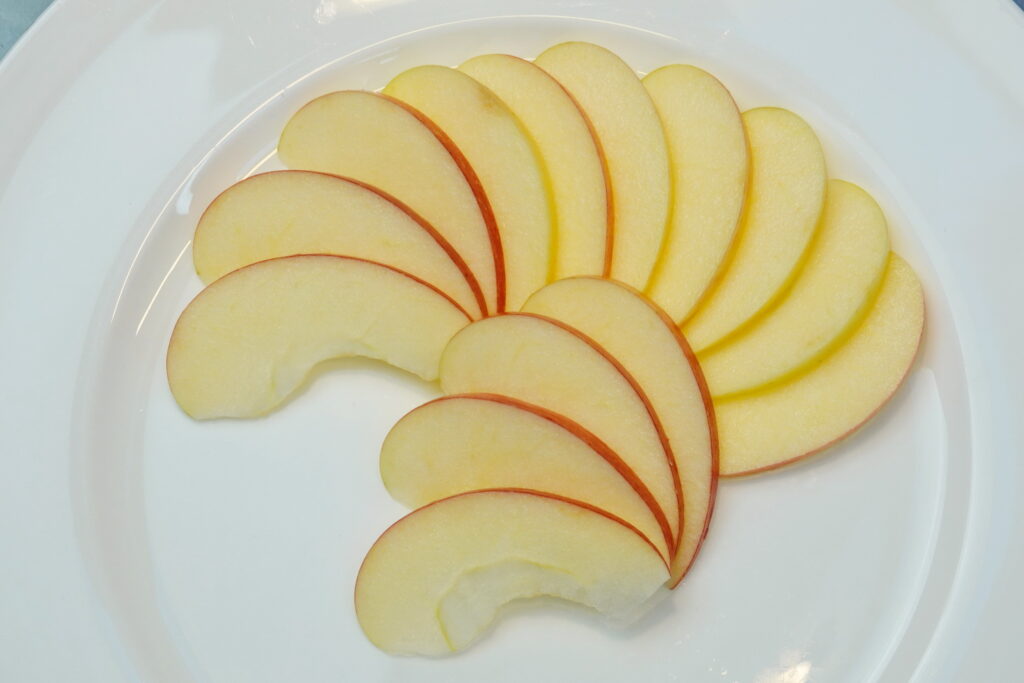
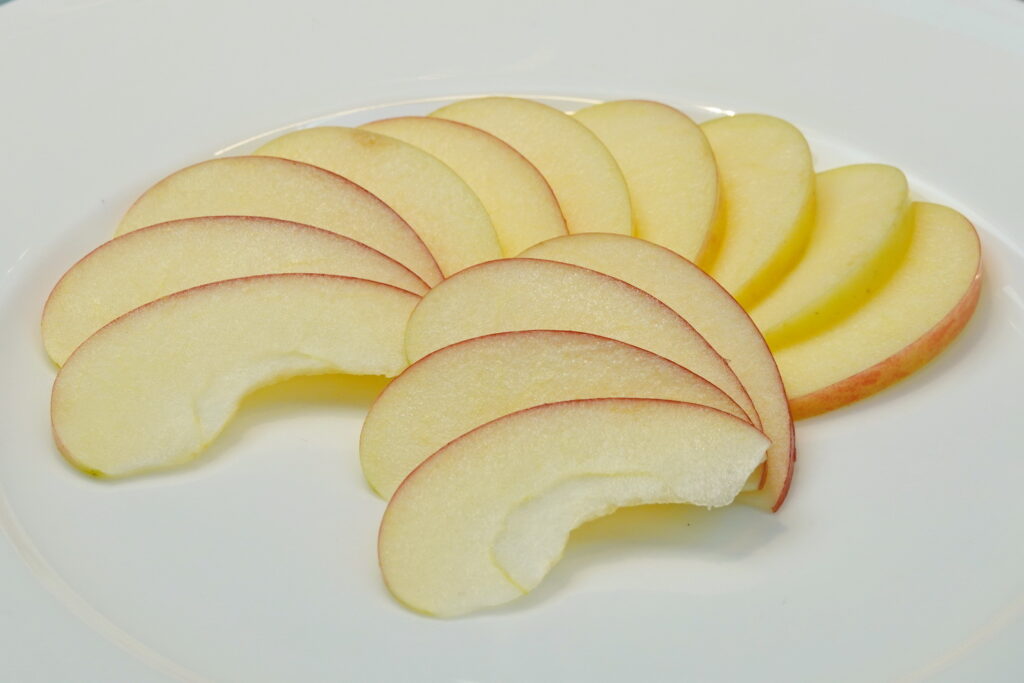
“With the apple slices, Venus evokes a sense of home.”
Ergebnisse des Geistigen Schauens vom 3. und 4. Oktober 2026
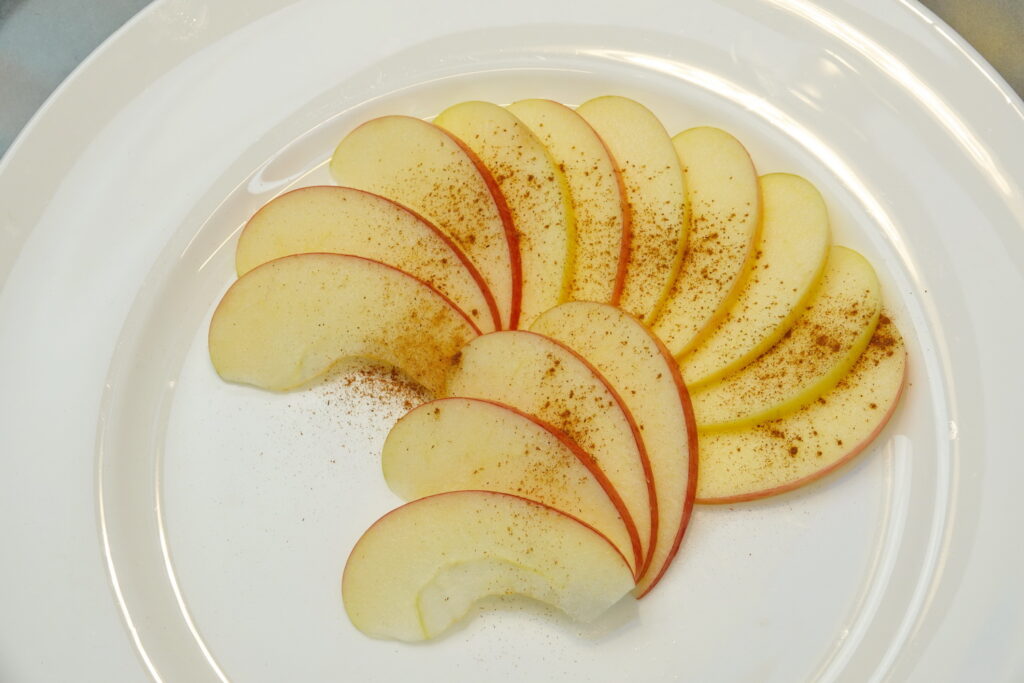

Heinz Grill, „Ernährung und die gebende Kraft des Menschen“, S.130
Fotos und Text: Lilly Zahara
Foto CrabApple: Martin Sinzinger
Foto Blühender Apfelbaum: Michael Schwarzenberger über Pixabay
- (0) Meditationsbrief Nr. 265 vom 26. Oktober 2024. Bei Interesse an den wöchentlich erscheinenden Meditationsbriefen von Heinz Grill wenden Sie sich an meditationsinhalte@mail.de
- (1) Wilhelm Pelikan, Heilpflanzenkunde, Bd. 1, Verlag am Goetheanum, Dornach 1988, S. 223
- (2) https://www.mein-schoener-garten.de/themen/pflanzen/zierapfel
- (3) https://www.bbg.org/article/marvelous_malus
- (4) Vgl. Artikel „Kulturapfel“ https://de.wikipedia.org/wiki/Kulturapfel
Eine Arte-Dokumentation unter dem Titel „Alte Gene für neue Äpfel“, Erstausstrahlung 2010, dokumentiert die Entdeckung der Wildapfel-Wälder Kasachstans für die westliche Welt.
https://www.youtube.com/watch?v=6o22c7Ry2JI
Da diese Dokumentation auf gentechnische Perspektiven für den großflächigen Erwerbs-Obstbau mit wenigen dominierenden Sorten abgestimmt ist, möchte ich an dieser Stelle ergänzend auf die traditionelle Sortenvielfalt hinweisen und stelle drei Links zu spezialisierten Baumschulen zur Verfügung, nur zur Durchsicht
www.baumgartner-baumschulen.de
www.baumschule-brenninger.de/apfelbaum
www.arche-noah.at/sortenerhaltung/obst-obstsammlung/sortenbeschreibungen - (5) Edward Bach, zitiert aus: „Bachblüten. Blumen die durch die Seele heilen. Die Bachblüten als bewusstes Gegenüber“ Stephan Wunderlich Verlag, 2020, S.77
- (6) Heinz Grill, „Ernährung und die gebende Kraft des Menschen“, Stephan Wunderlich Verlag, 8. Auflage 2013, S. 127.
- (7) Rudolf Steiner, Vorträge und Kurse für die Lehrer der Freien Waldorfschule Stuttgart, Teil III, Erziehungskunst, Seminarbesprechungen und Lehrplanvorträge, Zehnte Seminarbesprechung, Stuttgart, 1. September 1919, Rudolf Steiner Verlag 1984, GA 295, Zitat auf Seite 113 und Seite 116.
Vertiefend noch folgendes Zitat:
„Wie ist es mit diesem Baum? Ja, er hat da unten auch Wurzeln, allerdings, aber dann ist kein Stengel da, sondern ein Stamm. Dann breitet er erst die Äste aus, und dann ist es so, als ob auf diesen Ästen erst die eigentlichen Pflanzen wüchsen. Denn da sind viele Blätter und Blüten auf den Ästen darauf; da wachsen kleine Pflanzen wie auf den Ästen selber oben darauf. So daß wir tatsächlich, wenn wir wollen, die Wiese so anschauen können: Da wachsen zum Beispiel so gelbe Hahnenfüße über die ganze Wiese hin. Sie ist bedeckt mit einzelnen Pflanzen, die ihre Wurzeln in der Erde haben, und die da wachsen über die ganze Wiese hin. Aber beim Baum ist es, wie wenn man die Wiese genommen hätte, hätte sie hinaufgehoben, hätte sie gebogen, und dann wachsen erst da droben die vielen Blüten. Der Stamm ist ein Stück Erde selbst. Der Baum ist dasselbe wie die Wiese, auf der die Pflanzen wachsen.“
ebenda, S. 114f
Weitere Ausarbeitungen auf anthrowiki unter dem Stichwort „Baum“
https://anthrowiki.at/Bäume - (8) Gunter Steinbach, Das große biologische Gartenbuch, Teil 2: Der biologische Obstgarten, Wilhelm Heyne Verlag München, 1980, S. 26ff.
An dieser Stelle verweise ich auf Gunter Steinbach und nicht auf einen beliebigen der zahlreichen Internet-Artikel. Der 2002 verstorbene Autor hat sich mit seinem umfangreichen Werk an Sachbüchern für Kinder, Naturführern und Einführungen in den biologisch-dynamischen Gartenbau um die Vermittlung eines umfassenden Naturverständnisses äußerst verdient gemacht. Vgl. dazu auch den Wikipedia-Eintrag zu Gunter Steinbach mit einer Werkliste
https://de.wikipedia.org/wiki/Gunter_Steinbach
Heilpflanzenbeschreibung von Dr. Hauschka entnommen aus:
www.drhauschka.de/heilpflanzenlexikon/apfel - (9) Sigrid Hirsch, Felix Grünberger, „Die Kräuter in meinem Garten“, Freya-Verlag Linz, 2012, S. 53
- (10) Vgl. Tafel aus der Ausstellung „Selbsterziehung zu Gesundheit und Ökologie“, weitere Infos unter www.gesundheit-selbstaktiv.de
- (11) „Apfelpektine: Diese Substanzen werden bei fein geriebenen Apfel freigesetzt, schützen die Darmschleimhaut und adsorbieren Gifte und Krankheitskeime: Pektine werden im Darm zu monomeren Glakturonsäuren gespalten; an diese Säuren werden Toxine gebunden und anschließend ausgeschieden. Sie hemmen eine abnorme Darmflora sowie das Wachstum pathogener Keime. Pektin sorgt für eine naturgemäße Eindickung des Darminhaltes und trägt damit zur Normalisierung der Verdauung bei.“
Ursel Bühring, „Praxis-Lehrbuch Heilpflanzenkunde“, Haug-Verlag Stuttgart, 4. Auflage 2014, S. 183 - (12) Meditationsbrief 265 vom 26. Oktober 2024
- (13) Heinz Grill, „Die geistige Bedeutung des Zitrusbaumes sowie des Lorbeer- und Olivenbaumes.“ Sachsenheim-Häfnerhaslach, Deutschland: Lammers-Koll-Verlag, 2006, S. 6
- (14) „Äpfel und Birnen zählen zu den klimakterischen Früchten. Bis zur sogenannten Pflückreife werden Inhaltsstoffe in die am Baum hängenden Früchte eingelagert, erst nach der Pflückreife beginnen die Früchte am Baum oder am Lager zu reifen, bis sie die Genussreife erlangen. Im Unterschied dazu reifen nicht-klimakterische Früchte wie Erdbeeren oder Trauben nach der Ernte nicht weiter. Die Pflückreife ist eine Eigenschaft, die von Sorte zu Sorte variiert.“
https://www.arche-noah.at/media/lagerung_obst_teil1.pdf - (15) Der bereits oben zitierte Botaniker Wilhelm Pelikan, der immer bestrebt ist, Form- und Bildeprinzipien in den Pflanzenfamilien herauszuarbeiten, betont die besondere Fähigkeit der Rosengewächse, Zucker, Gerbstoffe und Zyan zu bilden. Vgl. Wilhelm Pelikan, Heilpflanzenkunde, Bd. 1, Verlag am Goetheanum, Dornach 1988, S. 223f
- (16) Am 19. Oktober 2024 schreibt Heinz Grill in seinem Meditationsbrief zur Aufgabenstellung:
„Der Übende, […] muss sich das sinnliche Bild des Apfels genau vergegenwärtigen und es bei den wiederholten Konzentrations- und Betrachtungsansätzen so weit in die Vorstellung führen, bis es sich vom Wesen und vom ätherischen Licht öffnet. Die Frage, wie das Wesen des Apfels erscheint, beantwortet sich aus dem Bild. Dieser Betrachtungsablauf, der zur Konzentration und schließlich zur Meditation führt, ist methodisch immer gleich. Er fordert ein Frei-Werden von eigenen Emotionen und mitgebrachtem Wissen.
Ein Apfel erscheint immer in einer weichen, hellen Lichtwirkung, die in der Regel sowohl im Apfel als auch in einem bestimmten Umkreis, etwa nahe um die Frucht erscheint. In weiterer größerer Umhüllung wird dieses Licht schwächer. Obwohl die Farbe des Apfels vielleicht schön anziehend rot sein kann, so erscheint dennoch das Licht in ihm und um ihn frei von der Materie und frei von der äußeren Schale. Es ist weich und leicht umhüllend, ohne den Betrachter einzuhüllen, fast wie schützend.
Wie wirkt das ätherische Licht auf die Physiologie des Menschen, welche gesundheitlichen
Wirkungen sind zu erwarten? Diese Fragestellung bildet nicht den Kern der Meditation, sondern es ist das Bild, das zur Konzentration über die sinnliche Erscheinung geführt wird. Aus diesem Grunde muss der fett gedruckte Satz zusammen mit dem Bild über den Apfel in die Betrachtung rücken. Will der Übende in diesen Meditationen gut gegründet sein, so darf er sich niemals an die Fragestellung fixieren, sondern er muss die direkte inhaltliche Wahrnehmung zum Objekt der Frage und zu dem inhaltlichen Meditationssatz in die Mitte der Aufmerksamkeit rücken.“ - (17) Meditationsbrief 263 vom 12. Oktober 2024
- (18) Aus einem Artikel von Heinz Grill, „Die geistige Bedeutung der Nahrungsmittel“, entnommen aus der Ausstellung „Selbsterziehung zu Gesundheit und Ökologie“, weitere Infos unter www.gesundheit-selbstaktiv.de
- (19) Heinz Grill, „Ernährung und die gebende Kraft des Menschen“, Stephan Wunderlich Verlag, 8. Auflage 2013, S. 127.
- (20) Heinz Grill, „Ernährung und die gebende Kraft des Menschen“, Stephan Wunderlich Verlag, 8. Auflage 2013, S. 128.
- (21) Siehe die Zusammenfassung „Ergebnisse des Kurses ‚Geistiges Schauen‘ vom 3. und 4. Oktober 2026 unter www.yoga-und-synthese-de
- (22) Ausführlichen Bericht zum Seminar siehe:
https://yoga-bewegungsschule.de/wp-content/uploads/2026/10/Ausfuehrliche-Beschreibung-zum-geistigen-Schauen-Webseite-aktuell.pdf - (23) Detaillierte Beschreibung der Vorgänge auf chemischer Ebene:
“Durch das Aufschneiden des Apfels werden die Zellstrukturen (Zellwände, Zytoplasma und Organellen wie z.B. Vakuolen) aufgebrochen und Luft tritt in die verletzten Zellen ein. Vakuolen sind von Membran umschlossene Hohlräume in der Zelle, die hauptsächlich Wasser und sekundäre Pflanzenstoffe beinhalten. Einer dieser Stoffe ist Polyphenol, der das Ausgansprodukt für die braune Farbe ist. Durch die Zerstörung der Vakuole kommt Polyphenol einerseits in Kontakt mit dem Luftsauerstoff und andererseits mit dem Enzym Polyphenoloxidase (PPO) aus der Zelle. Mit Hilfe des Sauerstoffs kann die PPO Polyphenol umsetzen (oxidieren). Dadurch entsteht Chinon – ein natürlicher Abwehrstoff der Pflanze gegen Mikroorganismen. Im Gegensatz zum farblosen Polyphenol weist Chinon eine eher gelbe Farbe auf. Es kann allerdings noch weiter umgewandelt werden, sodass braungefärbtes Melanin entsteht. Das ist jener Stoff, den man auch von der bräunlichen Färbung von Haut und Haaren kennt.”
entnommen aus:
https://www.hungryforscience.blog/warum-werden-apfel-spalten-braun/
Grundlage für die Beschreibung gesundheitlcher Wirkungen des Polyphenols auf Grundlage zum Beispiel der Veröffentlichgungen des Bundeszentrums für Ernährung (https://www.bzfe.de/presse/pressemeldungen-archiv/polyphenole-in-der-nahrung)